
AI Is Bigger Than Chatbots: Here’s Where the Real Business Value Lies
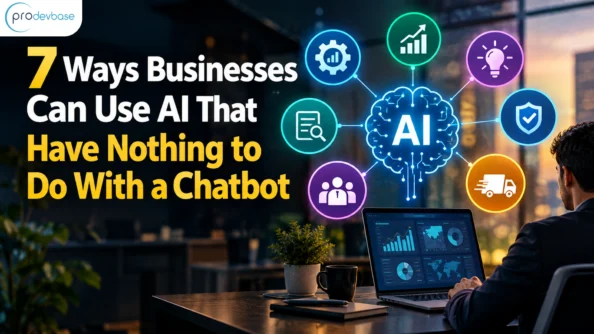
7 Ways Businesses Can Use AI That Have Nothing to Do With a Chatbot
Ask a founder what AI means for the business, and the answer is usually a chatbot on the website. That’s fair, because chatbots were the first AI tool regular people could touch. Still, they are a small slice of what’s possible. The real ways businesses can use AI show up in planning meetings, data warehouses, finance teams, and product roadmaps. So let’s walk through seven of them, with plain examples for each.
1. AI Strategy and Advisory
Plenty of AI projects fail before anyone writes a line of code. The cause is simple. Nobody agreed on the problem. Because of that, a strategy phase deserves real attention.
Good advisory work starts with a blunt audit. Where does time disappear? Which decisions rely on guesswork? After that, the team ranks ideas by value and effort. For instance, a distribution company might compare demand forecasting with invoice matching. One could save weeks of planning each quarter. The other might save an afternoon. Strategy makes that gap visible.
Prodevbase offers AI strategy and advisory for businesses that need a clear roadmap before committing budget. As a result, projects begin with a target, a metric, and an owner.
2. AI Data Engineering
Models learn from data, so weak data produces weak results. It’s that blunt. Yet data work rarely earns applause because it happens behind the scenes.
AI data engineering covers collection, cleaning, storage, and access rules. It also includes the pipelines that move information between systems. Take a retailer with separate tools for sales, inventory, and web analytics. Each one tells a slightly different story. Once the records merge into a single trusted source, forecasts become dependable. Likewise, clear governance protects customer privacy and keeps audits simple.
3. Custom AI and ML Development
Off-the-shelf tools are handy, but they’re built for the average case. A business with an unusual problem often needs a tailored fix. That’s where custom AI and ML development fits.
Consider a factory that wants to catch surface defects on a production line. A generic image tool won’t know what a flawed part looks like there. A model trained on the factory’s own photos will. Similarly, a lender can train a model on its own transaction history to flag suspicious activity. A clinic can predict missed appointments and adjust its schedule. In each case, the model fits the workflow instead of forcing a new one.
4. Generative AI
Generative AI writes, summarizes, translates, and drafts code. Hence it suits knowledge work, where people spend hours on first drafts and document searches.
A support team, for instance, can have replies drafted from past tickets. Then a support lead reviews and sends them. Marketing teams can build first-pass product descriptions in minutes. An internal assistant can also answer policy questions by searching company documents, which spares HR from repeating the same answers all week.
Still, people must stay in the loop. A fluent answer isn’t always a correct answer. Therefore, smart teams add review steps and brand rules before anything reaches a customer.
5. Agentic AI
A chatbot answers a question. An agent finishes a job. That’s the simplest way to separate the two.
Agentic AI handles multi-step tasks. It plans a sequence, uses connected software, checks its own output, and adjusts. Picture an incoming purchase order. The agent reads it, checks stock, updates the record, and alerts the warehouse. Meanwhile, a person steps in only when an item looks odd.
However, autonomy needs boundaries. Designers should set permissions, keep activity logs, and define when the agent must hand off to a human. Otherwise, small errors can spread quickly.
6. Intelligent Automation
Finance, HR, and operations teams still lose hours to repetitive work. Copying figures between screens is a classic case. Traditional automation helped, but it broke whenever a document looked different.
Intelligent automation adds AI to the rule-based approach. So invoices in ten formats can still be read, checked, and posted to the accounting system. Consequently, errors drop and approvals move faster. Staff also get time back for analysis and vendor relationships, which is where human judgment matters.
Prodevbase builds intelligent automation for businesses that want to cut manual effort in routine processes without replacing existing tools.
7. AI Product Engineering
Occasionally AI shouldn’t sit beside the product. It should be the product’s strength. AI product engineering builds features such as smart search, recommendations, personalization, and predictive alerts directly into software.
A fitness app might adjust workout plans from daily activity. A B2B platform might show risk scores right inside its dashboard. As a result, the product feels sharper, and users have fewer reasons to look elsewhere.
Prodevbase supports businesses that want AI built into their products, from architecture to release. Besides that, teams should plan for monitoring after launch, since model quality can drift as real-world data changes.
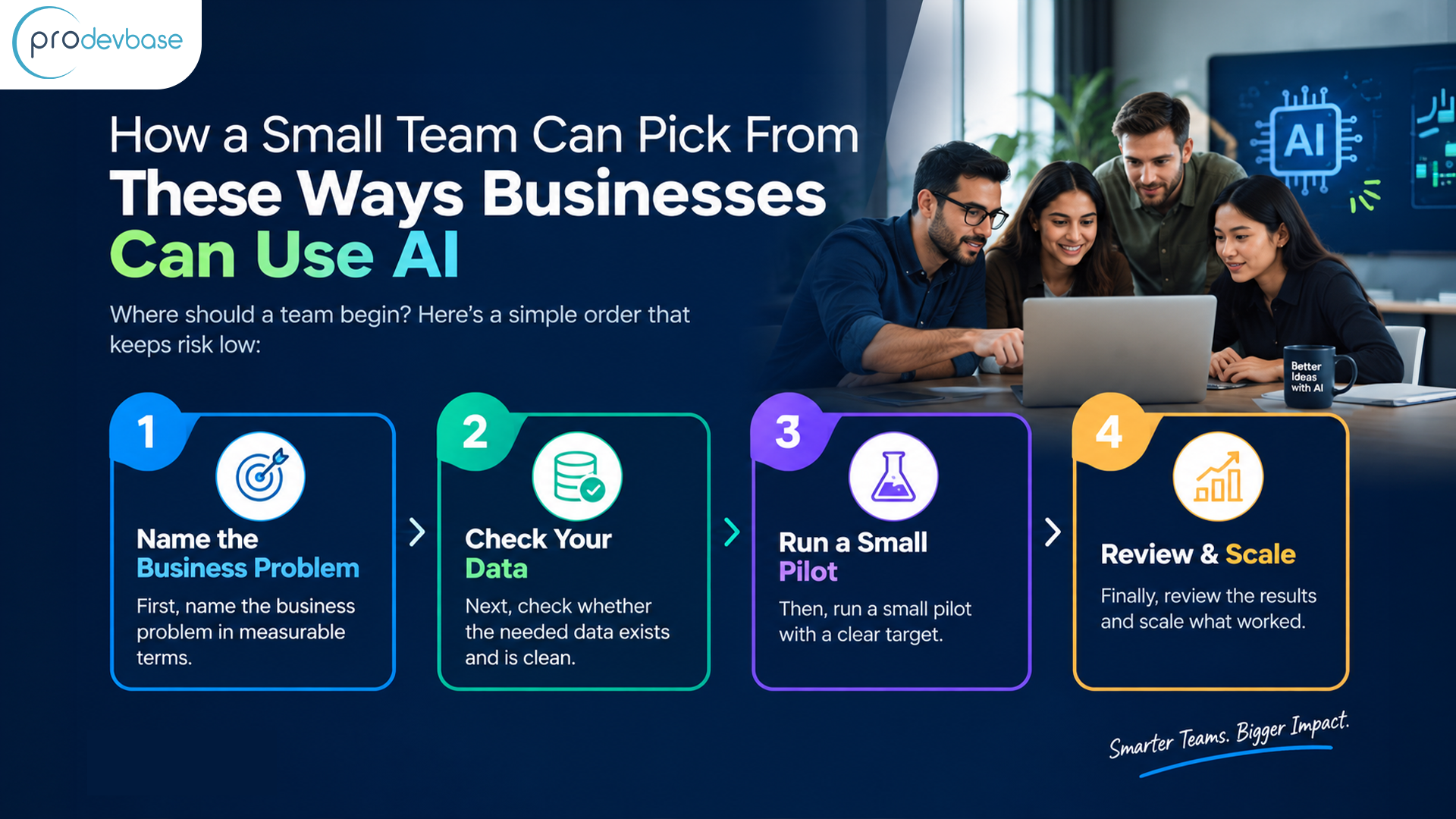
How a Small Team Can Pick From These Ways Businesses Can Use AI
Where should a team begin? Here’s a simple order that keeps risk low:
- First, name the business problem in measurable terms.
- Next, check whether the needed data exists and is clean.
- Then, run a small pilot with a clear target.
- Finally, review the results and scale what worked.
Because this sequence is cheap to test, it suits small budgets as well as large ones.
Conclusion
Chatbots opened the door, but they’re only the entrance. The ways businesses can use AI stretch across strategy, data, custom models, content, agents, automation, and product features. Each solves a different problem. So the smart move is matching the tool to the need, not chasing a trend.
Prodevbase works with businesses that need this kind of support, from the first roadmap through production launch. A short consultation can show which of these seven areas fits a current priority.