
How to Integrate Generative AI Into Enterprise Software for Smarter Business Growth
How to Integrate Generative AI Into Enterprise Software
Businesses already use software to manage customers, employees, finances, sales, and daily operations. But many of these systems still depend on manual data entry, repetitive tasks, and traditional ways of handling information. Generative AI is changing how businesses interact with their software. It can help employees find information, create content, understand documents, summarize reports, and handle customer requests. So let’s have a deep look into How to Integrate Generative AI Into Enterprise Software.
The real opportunity is not building another AI chatbot. It is connecting generative AI with the software a business already uses. Let’s explore how organizations can make this integration practical and useful.
What Does Generative AI Integration Mean for Enterprise Software?
Generative AI integration means adding AI capabilities to existing business applications so they can understand requests, process information, and generate useful responses.
For example, a company can connect an AI assistant to its CRM system. Instead of searching through multiple customer records, a sales representative can ask questions in natural language and receive a summary of customer activity.
Similarly, an AI-powered finance application can help review invoices, summarize financial reports, and identify information that needs further attention.
The goal is to make existing software more useful without replacing the systems employees already depend on.
Where Can Businesses Use Generative AI?
Generative AI can support different departments depending on their requirements.
1. Customer Relationship Management (CRM)
AI can summarize customer conversations, prepare follow-up emails, suggest responses, and help sales teams understand customer requirements. This reduces the time spent reviewing records and updating information.
2. Enterprise Resource Planning (ERP)
Businesses can use AI to search operational data, summarize reports, explain inventory information, and help employees access relevant business insights.
3. Human Resource Management
HR teams can use AI to answer employee questions, explain company policies, summarize applications, and assist with onboarding documentation.
4. Customer Support Software
Generative AI can understand customer messages, suggest relevant answers, summarize support tickets, and help support teams resolve common requests more efficiently.
5. Document and Knowledge Management
AI can search internal documents, summarize lengthy reports, and help employees find information across company knowledge bases.
Also read: AI Data Engineering in Finance: Powering Smarter Financial Decisions
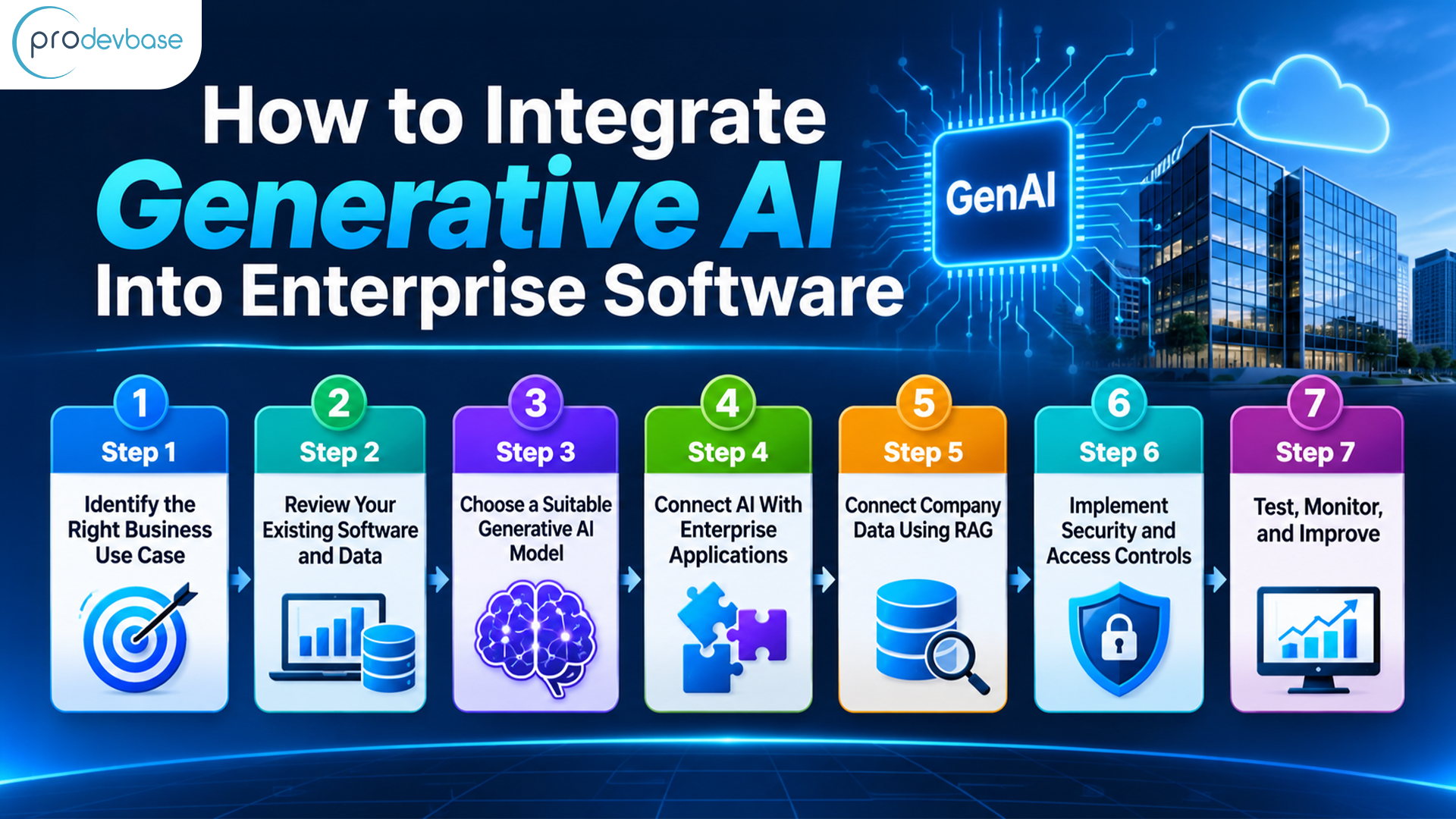
How to Integrate Generative AI Into Enterprise Software
Successful integration requires more than connecting an AI model to an application. Businesses need a clear implementation plan.
Step 1: Identify the Right Business Use Case
Start by understanding where employees spend the most time handling information. Look for processes involving document reviews, customer communication, internal searches, or repetitive support requests.
Choose one practical use case instead of trying to introduce AI across every department at once.
Step 2: Review Your Existing Software and Data
Identify the applications, databases, and internal documents the AI solution needs to access.
Check whether these systems support APIs or other secure integration methods. Also review data quality, user permissions, and existing security requirements.
Step 3: Choose a Suitable Generative AI Model
Select a model based on the application’s requirements, response quality, cost, privacy needs, and expected workload.
Businesses can evaluate services such as OpenAI, Google Gemini, and Azure AI. The right choice depends on the task and the organization’s technology environment.
Step 4: Connect AI With Enterprise Applications
Use APIs, middleware, or integration services to connect the selected AI model with existing software.
For example, an AI assistant connected to a CRM can retrieve authorized customer information, prepare a response, and suggest the next action to a sales representative.
Step 5: Connect Company Data Using RAG
For applications that need company-specific information, Retrieval-Augmented Generation (RAG) can be useful.
RAG allows an AI model to retrieve relevant information from approved company documents or knowledge sources before generating a response. This helps provide answers based on current business information rather than relying only on the model’s general knowledge.
Step 6: Implement Security and Access Controls
Enterprise applications often handle confidential business and customer information. Set role-based permissions, protect API credentials, encrypt sensitive data, and define which information the AI can access.
Important actions should also require employee approval where necessary.
Step 7: Test, Monitor, and Improve
Test the integration with real business scenarios before making it available across the organization.
Review response accuracy, processing time, system performance, security, and user feedback. Continue improving prompts, data retrieval, and application workflows as requirements change.
Technologies Used for Generative AI Integration
The technology stack depends on the existing enterprise environment and the solution being developed.
Some commonly used options include:
- AI Models: OpenAI, Google Gemini, and Azure AI.
- AI Development Frameworks: LangChain and LlamaIndex.
- Integration Technologies: REST APIs, middleware, and enterprise integration platforms.
- Data Storage: SQL databases, cloud storage, and vector databases.
- Cloud Platforms: Microsoft Azure, AWS, and Google Cloud.
- Monitoring Tools: Application monitoring, logging, and AI evaluation platforms.
Businesses should select technologies that work with their existing systems and can support future requirements.
Common Challenges When Integrating Generative AI
Enterprise AI integration can create new opportunities, but organizations should prepare for a few challenges.
- Data Privacy: Sensitive company information must be protected through appropriate access controls and security policies.
- Incorrect Responses: AI can generate inaccurate information. Use reliable data sources, response validation, and human review for important decisions.
- Legacy Software: Older applications may require additional integration work before they can communicate with AI services.
- Integration Costs: Model usage, infrastructure, development, and maintenance should be considered before implementation.
- Employee Adoption: Employees need practical training to understand how AI supports their existing responsibilities.
Addressing these challenges early can make implementation more reliable and easier to scale.
How Prodevbase Helps With Generative AI Integration
Every enterprise has different software, data, and operational requirements. A solution that works for one organization may not be suitable for another.
Prodevbase helps businesses explore and implement AI solutions that fit their existing technology environment.
Our capabilities include:
- Generative AI Development: Building AI-powered applications based on business requirements.
- Enterprise AI Integration: Connecting generative AI capabilities with existing business software.
- RAG Solutions: Helping applications retrieve relevant information from company data.
- Custom AI Solutions: Developing solutions for document processing, knowledge management, and business operations.
- Workflow Automation: Reducing repetitive tasks through intelligent application workflows.
Ready to Bring Generative AI Into Your Enterprise Software?
Generative AI can make enterprise software more useful by helping employees access information, understand business data, and complete everyday tasks more efficiently.
The best way to begin is to identify one business challenge, select the right AI approach, and integrate it with the systems your organization already uses.
Prodevbase helps businesses build and integrate practical generative AI solutions. Contact our team to discuss your enterprise AI requirements and explore the right approach for your business.
Conclusion
Integrating generative AI into enterprise software is not simply about adding a chatbot. It is about improving how existing applications access information, support employees, and handle business processes.
With the right AI model, secure data connections, reliable integration, and regular monitoring, organizations can build smarter software that supports their long-term business goals.
Follow us on LinkedIn for more insights on enterprise AI and intelligent automation.