
From AI Vision to Business Growth: How to Choose the Right Development Partner

How to Choose the Right AI Development Partner for Business Growth
AI Strategy & Advisory Starts With Trust
Choosing an AI development partner is a big decision. It can influence costs, timescales, and future business growth. An appropriate partner can effectively convert an initial concept into a functional solution, whereas an unsuitable one can cause major delays. So let’s know about How to Choose the Right AI Development Partner.
Business team analyzing AI development partner proposition
Whilst numerous providers claim to be able to provide rapid delivery, in reality only a small number can truly do this. Prodevbase, for example, combines consultancy, engineering and support within one partnership. This results in a partner who fully understands both the strategy and code.
Appropriate partners safeguard data and manage risks well. They also ensure that the project remains aligned to the business’ aims. Consequently, organizations can launch their solutions swiftly and avoid costly rework.
Identifying Business Objectives
Leaders within an organization must identify exactly what issue they wish to resolve with AI, perhaps to reduce support costs, improve forecasting, or enhance recommendation functionality. Clearly identifying these aims simplifies the evaluation of potential partners. If leaders identify no objectives, all propositions tend to appear similar, and therefore decisions must often rely on intuition.
Evaluating Technical and Industry Competence
Analyze the technical skill sets available. Ideally, these will include machine learning, natural language processing, and data engineering. Furthermore, relevant industry expertise is key. Different sectors, for example, healthcare, retail, and finance, are subject to differing legislation. As a result, partners with industry experience will assimilate rapidly and will also be far less likely to make mistakes.
What to Seek in an AI Development Partner
- Experience: First, this is evidenced through case studies and references, so that leaders can verify that past projects were successfully deployed and produced meaningful outcomes.
- Technical competence: In addition, our own team is highly rounded and includes data science, MLOps, cloud, and software engineering.
- Communication: Likewise, together with frequent reporting and joint dashboards, information is effectively shared using accessible language.
- Data security and regulatory compliance: Equally important, strong data encryption and management coupled with compliance with regulations (for example GDPR) are extremely effective ways of securing data.
- Extensibility: Also, ideally the solution can easily expand to accommodate increased web traffic, data, and functionality without the need for a total re-development.
- Costs: Finally, ideal partners will offer fixed scope, detailed costings and well-signaled progression points so that unexpected expenditure does not occur.
Popular AI Applications
Following narrowing down of potential partners, the appropriate AI application can then be matched to business requirements. Examples of areas in which suitable partners can effectively and rapidly apply AI are shown below.
- Automated customer service: For example, chatbots can handle common customer queries around the clock. Complex matters are then passed onto a member of staff.
- Predictive analysis: Similarly, retailers are also utilizing this to predict stock requirements and thus avoid both over- and understocking.
- Data extraction: In the insurance industry, for example, claims data can now be rapidly analyzed from forms rather than taking several hours to do so manually.
- Tailored suggestions: In the same way, as with online streaming and shopping portals, relevant items can be suggested based upon an individual’s viewing or purchasing history.
- Money laundering detection: Likewise, banks are using AI to instantly recognize potentially illicit activity and so limit their financial exposure.
- Manufacturing inspection: Meanwhile, computer vision is also being used within this sector to spot production line imperfections.
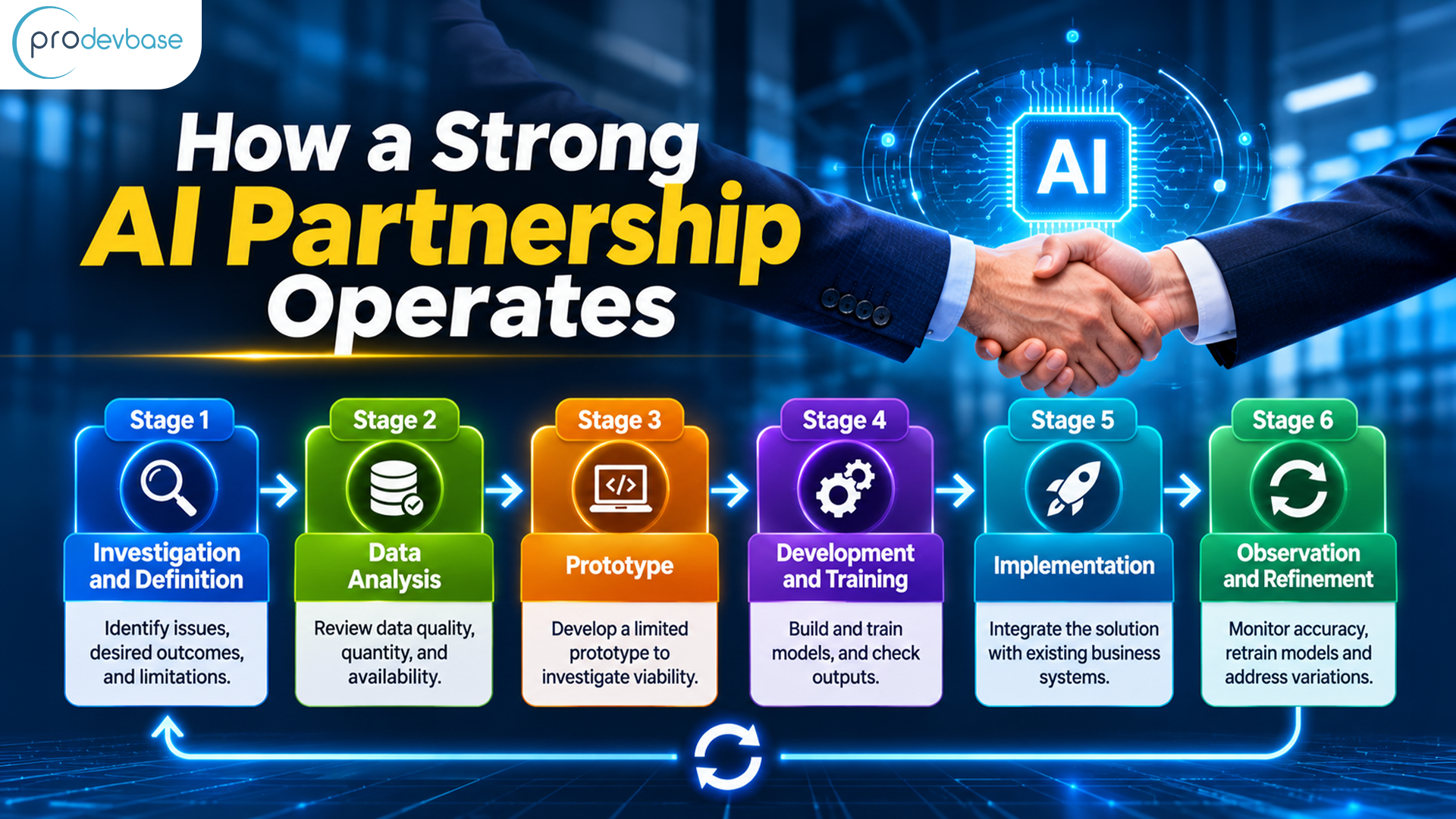
How a Strong AI Partnership Operates
Whilst each project will differ, a good partner will typically follow the following methodology:
Stage 1 Investigation and Definition: To begin, stakeholders and the partner collaborate to identify issues, the desired outcomes, and limitations.
Stage 2 Data Analysis: Next, a review is undertaken of data relating to its quality, quantity, and availability. Consequently, any deficiencies are highlighted at this stage prior to development.
Stage 3 Prototype: Then, a limited prototype is developed and utilized to investigate viability. Simultaneously, the business begins to realise benefits, and this is done at minimal risk.
Stage 4 Development and Training: After that, engineers construct and train models. Afterwards, outputs are checked against previously defined standards.
Stage 5 Implementation: Subsequently, the devised solution is integrated with current business systems such as CRM, ERP, and mobile applications.
Stage 6 Observation and Refinement: Finally, the partner observes outputs to ensure that they remain accurate. Models are subsequently retrained and variations addressed. This whole procedure is continually repeated as objectives change.
Tools and Techniques that a Partner should Be Familiar With
Good partners will utilize the best-fitting tool for a given task instead of simply following trends. It can therefore be valuable to ascertain which tools a partner’s team employs and the reasons for this. Below are typical areas:
- Machine Learning: For instance, tools including TensorFlow, PyTorch and scikit-learn can all be used to develop models, which may range in complexity from regression to deep learning.
- Cloud: Likewise, AWS, Microsoft Azure and Google Cloud all offer scalable cloud computing, storage and AI services.
- Data Engineering: In addition, software such as Apache Spark, Airflow and Snowflake can all analyze, transfer and structure data.
- MLOps and Observations: Finally, tools including MLflow, Kubeflow and Docker all facilitate easy implementation, version control and observation.
Alongside tools, a good partner will be able to convey how models are evaluated and recorded. Furthermore, good recording is essential in order for internal staff to later manage and continue development. The NIST AI Risk Management Framework is a sound and well-respected source for responsibly implementing AI. Essentially, though, the best partners will educate clients throughout the development process.
Ready to Start the Conversation?
Prodevbase assists businesses in practically devising, developing, and expanding AI functionality. Explore our AI services page to observe how we do this and then arrange a complimentary consultation meeting to begin working on an initial project. IT Services and Digital Consulting Agency | ProDevBase
Conclusion
A suitable AI development partner will have the relevant technical skills, industry expertise, and honest communication skills and will furthermore apply a proven methodology. Firstly, however, ascertain the business objectives. Then evaluate potential partners using these criteria. Finally, initiate proceedings by working on a limited scale. By doing so, risk is strongly minimized, and self-confidence is enhanced.
Prodevbase offers AI strategy, bespoke model development, and automation, along with support so that a business can fulfil its requirements. Contact us today and begin to create genuinely valuable AI functionality.