
How to Calculate AI ROI: Turn Your AI Investment Into Measurable Business Growth

How to Calculate AI ROI Before Investing in Custom AI
What Is AI ROI and Why Does It Matter?
AI ROI shows a business the return on the money it has invested in an AI project. Even though the concept is simple, many teams fail to carry out this step; instead, they concentrate on the excitement and hope that the figures will turn out all right later on. So let’s have a look at How to Calculate AI ROI.
That habit starts to cost a great deal very soon. If you decide to develop a custom AI solution, then you have to pay for its development, for the preparation of the data, and for maintenance.
Because of this, it is useful to carry out an initial calculation so that managers can compare the project with other alternatives.
The figure for the AI’s return on investment also prompts further discussion; the finance, engineering, and leadership departments now have identical sets of figures, which in turn results in faster approvals and more realistic expectations.
Hard Returns vs. Soft Returns in AI ROI
When measuring the return on investment (ROI) for AI projects, you can look at both hard returns and soft returns.
Hard Returns
Hard returns are direct financial gains. These include increased sales, lower costs, or higher profits that AI helps create.
For example, if an AI tool automates data entry, the company can save on labor costs. If a chatbot helps customers place more orders, sales may go up. You can measure these results in dollars.
Soft Returns
Soft returns are benefits that do not show up right away as money. These include better customer satisfaction, improved decision-making, or stronger brand reputation.
For example, an AI system that speeds up customer service responses can make people happier with the company. Over time, this can lead to more loyal customers or good word of mouth. These results are harder to measure, but they still matter.
Both hard and soft returns are important when you judge the value of an AI project. Companies should try to track both types of results to get a full picture of how AI affects their business.
Tangible and Intangible Returns
If you examine the return on investment (ROI) associated with artificial intelligence (AI), you will discover both tangible and intangible returns. Hard returns refer to clear and measurable outcomes. For instance, AI can reduce labor costs, speed up tasks, or increase sales. Companies are able to monitor these changes using figures and thus observe the direct financial impact.
Soft returns are not as direct; they involve things such as greater customer satisfaction, an improved brand reputation, or higher employee morale. Although these outcomes are important, they are more difficult to measure and might not appear immediately on a balance sheet.
Soft returns are more difficult to handle. Even though improvements in customer experience, quicker decisions, and lower risk are all important, it is harder to put a price on them.
Nevertheless, you should not ignore these factors; rather, you should attach to each a cautious estimate.
You should also watch out for the possibility of double counting; if the better support results in higher sales, then the amount of that increase should be counted only once; otherwise, the AI return on investment figure will fail to gain credibility.
Also read: Intelligent Automation in Finance: Powering Smarter, Faster Operations
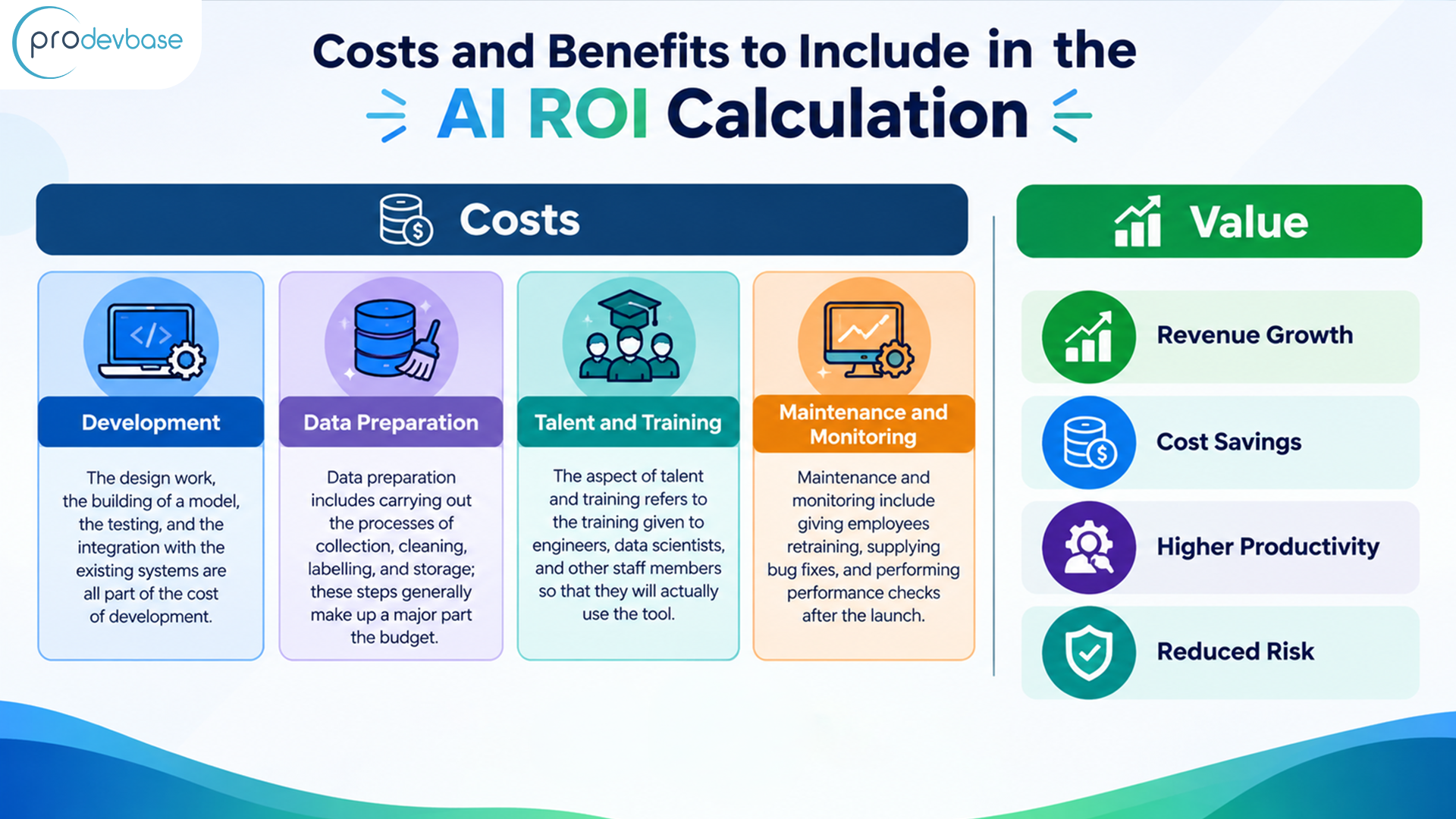
What Costs Should You Include in an AI Investment?
- Development – The design work, the building of a model, the testing, and the integration with the existing systems are all part of the cost of development.
- Data Preparation – Data preparation includes carrying out the processes of collection, cleaning, labelling, and storage; these steps generally make up a major part of the budget.
- Talent and Training – The aspect of talent and training refers to the training given to engineers, data scientists, and other staff members so that they will actually use the tool.
- Maintenance and Monitoring – Maintenance and monitoring include giving employees retraining, supplying bug fixes, and performing performance checks after the launch.
- Value – The value will include revenue growth, cost savings, higher productivity, and reduced risk.
Where Custom AI Delivers Measurable Returns
Certain business areas do provide clear figures; hence, they are suitable as a starting point for an AI ROI model.
- Customer Support – The system for handling customer support now has chatbots dealing with standard inquiries, which enables the agents to focus on more complicated cases and thus leads to a reduction in the cost per ticket.
- Demand Forecasting – To forecast demand, a retailer has to predict sales accurately in order to avoid having too much stock and to prevent missing out on sales.
- Predictive Maintenance – Because of predictive maintenance, a factory can pick up equipment faults at an early stage and thereby avoid costly downtime.
- Fraud Detection – A bank can detect fraud by spotting suspicious transactions as they occur and thereby decrease financial losses.
- Lead Scoring – The sales team evaluates leads according to their buying intent and is therefore able to close deals more quickly.
- Claims Processing – The insurer automatically extracts the data from the claims and speeds up the process of approving them.
How Do You Calculate AI ROI?
- Step 1 – The first step is to identify the business problem: that is, you must state the problem in question. For instance, if you aim to reduce returns by 15%, you will then be able to measure the results later.
- Step 2 – In the second step, we set up baseline figures and at the same time note the present level of performance, because it would be impossible to show any improvement without having such a baseline.
- Step 3 – In step 3, you must work out the total costs by drawing up a list of both one-off and ongoing expenses and make sure that you do not fail to include the indirect ones, such as data cleaning and monitoring.
- Step 4 – In the fourth step, you must predict the benefits: work out the expected reductions in costs and the revenue increases. To achieve this, draw up conservative, base, and optimistic scenarios so as to show a realistic range.
- Step 5 – In stage 5, carry out the AI return on investment and payback calculation: as soon as the figures are available, use the formula and also work out the payback period and net present value, since gains in the future are worth less than those which are available at present.
- Step 6 – In step 6, carry out the idea on a small scale as a pilot since the assumptions can only be verified by examining the results of the pilot before any full-scale investment is made.
You might missed to check: AI Strategy and Advisory
Tools and Technologies for Measuring AI ROI
Using the right tools will make the calculations quicker and more accurate and will also ensure that the results are consistent within teams, so four categories should be examined.
- Spreadsheet and Financial Modelling – Tools for spreadsheet work and financial modelling, such as Excel and Google Sheets, can handle scenario models, payback periods, and sensitivity tests.
- Business Intelligence – Intelligence platforms such as Power BI, Tableau, and Looker keep records of the basic metrics and show the results on live dashboards.
- Cloud Cost Management – Tools available for managing cloud costs, including AWS Cost Explorer, Azure Cost Management, and Google Cloud Billing, give a detailed account of the money spent on infrastructure.
- Model Monitoring – Tools like MLflow, Weights & Biases, and Evidently AI record changes in model accuracy, drift, and performance over time.
Although tools may offer a certain amount of assistance, it is expert advice that makes the real difference. A person who has both technical and financial experience is capable of spotting risks at an early stage.
For instance, Prodevbase allows businesses to develop realistic AI return-on-investment models before development starts, thereby making sure that each investment is based on solid data.
Conclusion
The most reasonable action to take before making any kind of investment in custom AI is to work out the return on investment. To begin with, you should clearly define the problem and set a baseline; then estimate the costs, predict the benefits, and afterwards verify all this with a pilot. In this way, executives can avoid wasting money and instead provide funding for projects which actually turn out to be worthwhile.
Prodevbase offers a variety of AI services, including custom development, automation, and consulting, all of which are designed to meet business requirements.
It would be a good idea now to contact them so that their team can turn a good idea into a real return.