
How to Build an Enterprise AI Roadmap That Delivers Business Results

Enterprise AI Roadmap: Turn Your AI Vision Into Measurable Business Growth
AI Strategy: A Practical Path from Vision to Value
An enterprise AI roadmap takes the disparate tests and turns them into a clear plan with measurable objectives. Without a roadmap, pilots will peter out, budgets will get out of hand, and leadership will start to lose faith. A good roadmap is just as important as the technology itself. So let’s know more about Enterprise AI Roadmap.
Firstly, the roadmap links each project to a business goal. Then it has owners, dates, and budgets. As a result, the teams know what to build, why it’s important, and how to measure success.
A good plan will also strike a balance between quick wins and long-term bets. That balance is what builds trust early on. It also keeps spend in line with strategy.
Why Enterprise AI Projects Fail Without a Roadmap
Several projects fail due to a lack of clarity around the objective. For example, think of a project launched with a chatbot, with no definition of the problem it’s actually intended to solve. As a result, uptake is minimal, and the pilot dies. Poor data and weak rules are also major causes of delay. Besides that, split ownership is another issue, which can lead to a very slow decision-making process. An enterprise AI roadmap is the structure that prevents all of these failures.
Also read: How to Build an AI-Powered Sales Automation System Using AI Agents
What a Strong Roadmap Looks Like
A good roadmap is short, visible, and flexible. It starts with a one-line vision statement. It then lists the priorities by value and by ease. It is reviewed each quarter so that the plan can evolve in response to new data. Finally, it ends with the metrics that prove progress is being made.
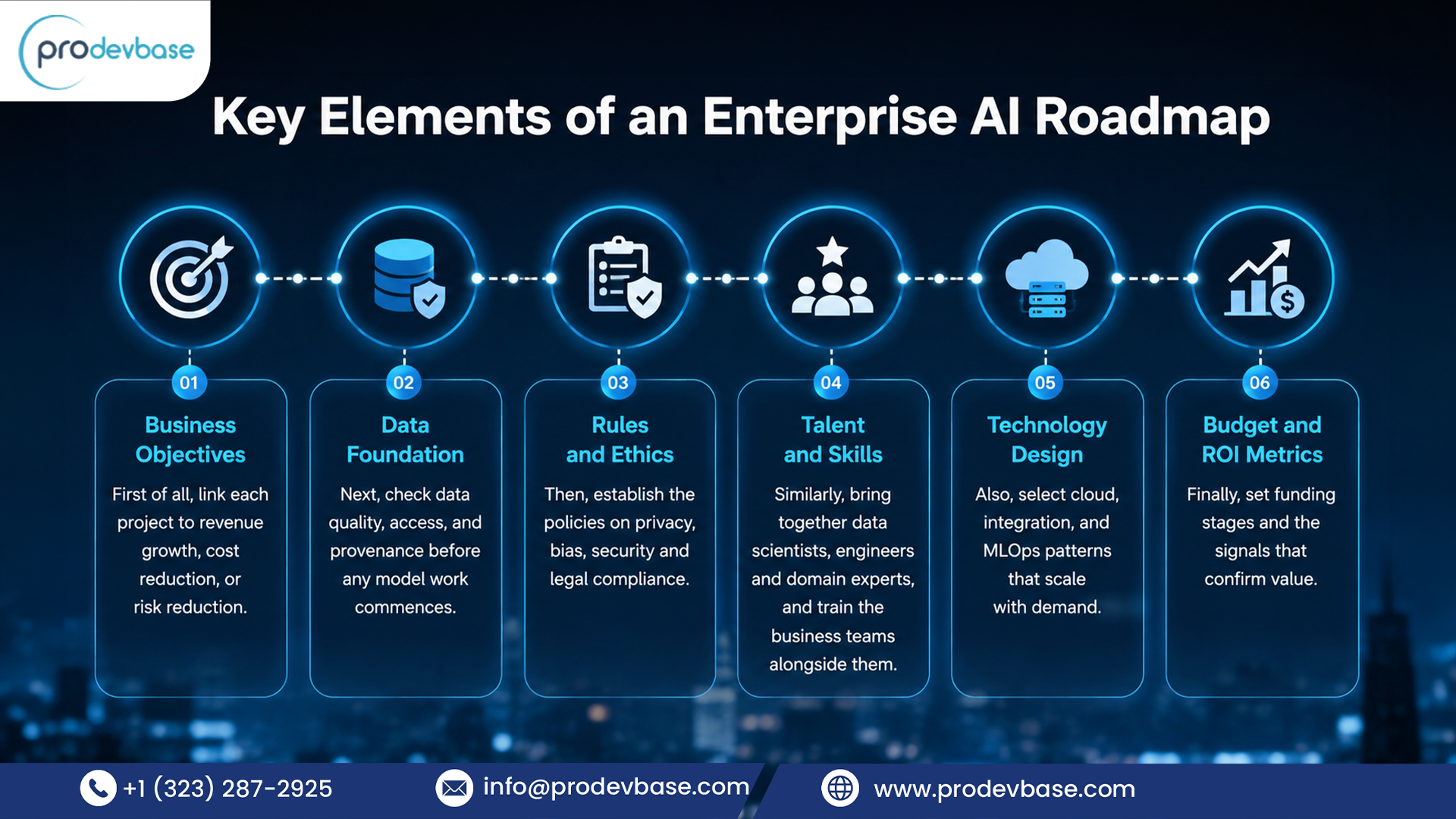
Key Elements of an Enterprise AI Roadmap
- Business Objectives – First of all, link each project to revenue growth, cost reduction, or risk reduction.
- Data Foundation – Next, check data quality, access, and provenance before any model work commences.
- Rules and Ethics – Then, establish the policies on privacy, bias, security and legal compliance.
- Talent and Skills – Similarly, bring together data scientists, engineers and domain experts, and train the business teams alongside them.
- Technology Design – Also, select cloud, integration, and MLOps patterns that scale with demand.
- Budget and ROI Metrics – Finally, set funding stages and the signals that confirm value.
High-Impact Enterprise AI Use Cases
The right use case will give early momentum. A project with clear data and clear outcomes will deliver value much faster. The examples below are therefore ones where enterprises have actually seen a return.
- Customer Support Automation – For instance, an AI assistant deals with the standard tickets, while the human agents deal with the complex ones.
- Demand Forecasting – For example, a retailer forecasts seasonal sales in order to avoid both stockouts and excessive stock.
- Predictive Maintenance – Similarly, the factory looks at the sensor data to fix the machines before they break.
- Fraud Detection – In the same way, a bank will score a transaction in real time to flag anything suspicious.
- Document Intelligence – As a result, the legal team can pull clauses out of contracts in minutes rather than days.
- Personalized Marketing – Likewise, an online brand will suggest products based on browsing and purchase history.
Step-by-Step Process to Build an Enterprise AI Roadmap
Step 1 – Align on Business Goals: First, start with leadership workshops and then turn the strategic goals into specific, measurable AI outcomes.
Step 2 – Assess Readiness: Next, go and look at the data, the systems, the skills, and the culture. Consequently, the gaps will be obvious before any money is actually committed.
Step 3 – Prioritize Use Cases: Afterward, score each idea on value, ease, and risk and then pick two or three to start with.
Step 4 – Set the Rules and Tech Design: In addition, write the ethics policies, the security controls, and the scalable technical plan. That way, subsequent projects can all build on the same base.
Step 5 – Pilot, Measure and Learn: Meanwhile, run small pilots with clear success criteria in mind. Then compare the results to the baseline and iterate accordingly.
Step 6 – Scale and Optimize: Finally, take the proven solutions and roll them out across the organization. In parallel, monitor performance and update the enterprise AI roadmap on a quarterly basis.
Tools and Technologies That Support the Roadmap
Technology should be chosen to meet business needs, not the other way around. Likewise, the tools selected should work with the systems already in place. That’s why Prodevbase helps organizations to compare options as part of the planning process, helping to keep both cost and complexity in check.
- Data Platforms – For example, Snowflake, Databricks and Google BigQuery are used for storing and preparing large datasets for analytics and training.
- Model Development – Likewise, TensorFlow, PyTorch, and scikit-learn all support machine learning, deep learning, and generative AI projects.
- MLOps and Deployment – In addition, MLflow, Kubeflow and Docker all automate the training pipeline, versioning and release.
- Monitoring and Oversight – Finally, tools like Evidently AI and cloud dashboards will track drift, bias, and performance after launch.
Even so, tools in themselves won’t deliver results. It’s all down to ownership, consistent measurement, and open communication. That’s why leaders should look at progress against business metrics rather than technical ones.
Ready to Build an Enterprise AI Roadmap That Works?
Start with a focused assessment and a ranked plan. Prodevbase can take organizations through the entire process from strategy to launch. So get in touch with the team today to book a consultation.
Conclusion
An enterprise AI roadmap is a plan that brings together vision, data, people and technology. The key thing it does is link each project to a business outcome, so progress can actually be measured. In essence, organizations that plan properly, pilot judiciously, and scale in a measured way will achieve significantly better returns than those who just go out and experiment.
Prodevbase also offers AI consulting, custom model development, and deployment services tailored to each business need. Reach out today, and turn the roadmap into results.