
How Healthcare Organizations Can Use Intelligent Automation to Improve Operational Efficiency
How Intelligent Automation Is Transforming Healthcare Operations?
Patient volumes keep climbing. Staffing hasn’t kept pace. Billing cycles get more complicated every budget cycle. Put those three together, and it’s easy to see why intelligent automation has moved out of the pilot project bucket and into everyday operations at hospitals, clinics, and specialty practices. Efficiency, once treated as a nice-to-have, has quietly become a requirement for staying financially viable. So let’s know about How Does Intelligent Automation Improve Healthcare.
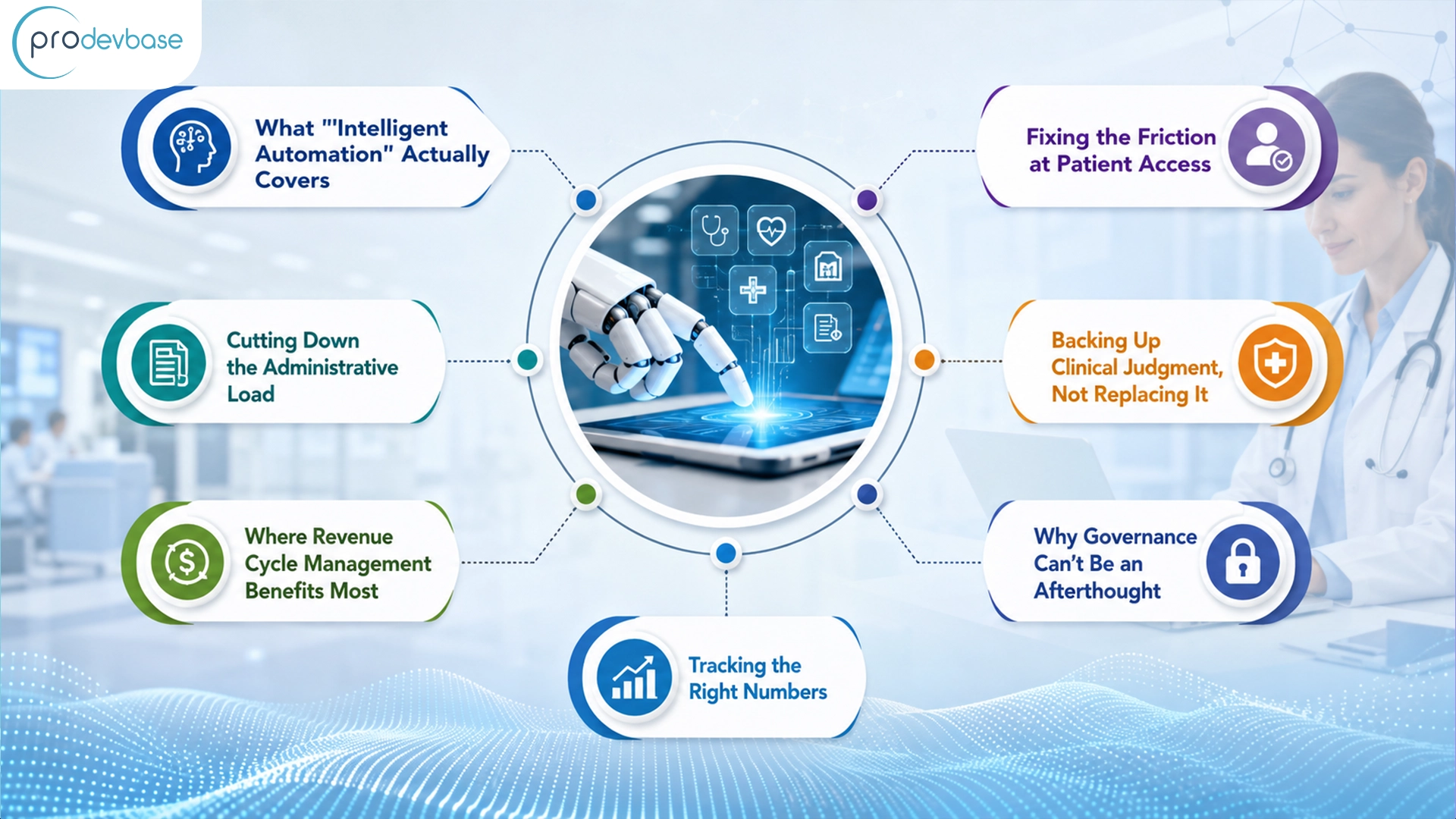
What “Intelligent Automation” Actually Covers
The term gets used loosely, so it helps to be specific. Intelligent automation blends robotic process automation (RPA), AI, and workflow orchestration to take on tasks that used to demand constant human attention. Older, rules-only automation broke the moment something unexpected happened. This version doesn’t. It flags exceptions, learns from recurring patterns, and can trigger the next step across multiple systems without waiting for someone to push a button. That’s the real shift. It isn’t just back office paperwork anymore. It touches scheduling, intake, care coordination, and revenue cycle work too.
Also read: How AI Product Engineering Is Transforming Healthcare & Patient Care
Cutting Down the Administrative Load
A large chunk of clinical staff time still goes to tasks that have nothing to do with treating patients. Scheduling appointments, verifying insurance, and chasing documentation are the usual culprits. These tasks are repetitive and rules based, which makes them a natural fit for automation. Once intake, eligibility checks, and routine follow up messages run automatically, front desk staff get their time back. That time goes toward patients instead of paperwork. Documentation tools built on this kind of automation have already cut documentation time significantly in practice. That matters, because time pressure is one of the bigger drivers of staff burnout.
Where Revenue Cycle Management Benefits Most
Billing, claims, and denial management are where automation tends to pay off fastest. The work is repeatable and pattern-heavy. That also means it’s exactly where manual processes introduce costly errors. When automation is paired with operational insight, billing teams start catching problems before a claim gets denied instead of after. Workflows get optimized, and denial rates drop. One healthcare revenue cycle operation automated its document-heavy processes and reported saving over 15,000 employee hours a month. Documentation time fell by 40 percent in the same period. That’s not a marginal improvement. It changes what a finance team can realistically get through in a week.
Fixing the Friction at Patient Access
Patient access is usually where problems start. Long waits, scheduling conflicts, and manual benefits checks slow the entire visit down before care even begins. Automating scheduling, intake, and verification improves throughput. It also tightens the front end of the revenue cycle. Small inefficiencies at check-in rarely stay small. Left unaddressed, they turn into revenue leakage further down the line. Fixing intake early has effects that ripple through the rest of the operation.
Backing Up Clinical Judgment, Not Replacing It
Automation isn’t confined to admin work. Predictive tools now support sepsis identification, readmission risk prediction, imaging prioritization, and care pathway recommendations. Still, none of that replaces a clinician’s judgment. It just gets relevant information in front of them faster. Response times improve because someone catches an early warning sign sooner, not because a machine made the call instead of them.
Why Governance Can’t Be an Afterthought
None of this works well without groundwork. Automation built on inconsistent or poorly governed data tends to create new discrepancies rather than solving old ones. Organizations that put real governance frameworks in place before scaling automation move faster once tools go live. They also trust those tools more, because the underlying data holds up. Staff training matters just as much. People need to know how to work alongside these systems, not just watch them run.
Tracking the Right Numbers
Success here should show up in specific places. Shorter patient wait times, faster claims turnaround, fewer documentation errors, and better coordinated care are the clearest signs. Building these metrics directly into automation budgets keeps a project accountable. Measuring them as an afterthought doesn’t. Skip that step, and automation risks staying a collection of disconnected pilots that never add up to anything.
Where Prodevbase Fits In
Rolling out intelligent automation takes more than buying software. It takes careful workflow design, integration work, and governance planning. That’s the piece Prodevbase handles for healthcare providers. The approach centers on building automation around existing clinical and administrative workflows, not forcing a disruptive overhaul. The focus stays on measurable outcomes, so automation efforts turn into real efficiency gains rather than sitting on a slide deck.
The Bottom Line
Intelligent automation is already changing how healthcare operations run, from the first patient touchpoint through revenue cycle and clinical decision support. But the technology alone won’t get an organization there. Governance, staff training, and clear measurement have to come with it. Providers who treat automation as a strategic project tend to come out ahead. Working with the right partner, like Prodevbase, from the start makes that outcome more likely, without cutting corners on patient care.