
Custom AI Development for Healthcare: Transforming Patient Care with AI
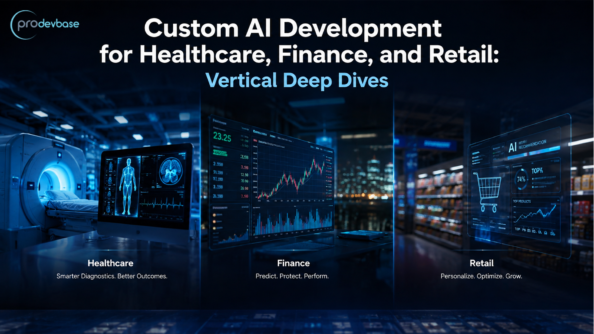
Custom AI Development for Healthcare, Finance, and Retail: Vertical Deep Dives
Custom AI development is changing how healthcare providers, financial institutions, and retailers solve real problems. Off-the-shelf software rarely fits complex workflows. Tailored AI, on the other hand, works around actual data, real processes, and specific business goals. As a result, industries with strict rules or unusual demands now choose custom-built systems over generic tools. So let’s know about Custom AI Development for Healthcare.
Prodevbase builds AI systems for healthcare, finance, and retail businesses. Each system fits real operations instead of forcing teams to adapt to rigid platforms. Each industry follows its own regulations, data types, and risk factors. A strong AI solution needs that context from day one.
This article looks at custom AI development across three major industries. It also explains why tailored solutions outperform generic alternatives.
Why Vertical-Specific AI Outperforms Generic Tools
Generic AI platforms serve a wide range of use cases at once. Because of this broad focus, they often miss the details that individual industries need. Finance relies on strict regulatory language. Healthcare depends on precise diagnostic terms. Retail follows seasonal buying patterns that shift constantly.
Custom-built AI models train on data specific to an industry. They also follow the rules that govern that industry closely. Therefore, results tend to stay accurate, relevant, and easy to act on. Teams can also adjust these models over time as regulations change or business needs shift. Generic tools, in contrast, stay fixed and rarely adapt.
This flexibility explains why vertical-specific AI has become the preferred choice. Companies that cannot afford errors, delays, or compliance gaps benefit greatly from this approach.
Healthcare: Precision, Compliance, and Patient Outcomes
Healthcare data is sensitive, tightly regulated, and often unstructured. For this reason, clinical AI models need strict attention to accuracy and privacy from the outset.
Key applications include:
- Diagnostic support: AI models trained on imaging data help radiologists spot patterns that might otherwise go unnoticed. This supports faster, steadier diagnoses.
- Clinical documentation: Natural language tools turn physician notes into structured records. This cuts administrative work significantly.
- Predictive analytics: Machine learning models forecast patient readmission risk. Care teams can then step in earlier.
- Compliance-first design: HIPAA and similar rules govern how healthcare teams store and process patient data. Custom AI systems build in encryption, access controls, and audit trails from day one.
Since healthcare outcomes affect patient safety directly, testing and validation stay especially strict. Development timelines in this space often include extended clinical review before deployment.
Finance: Risk, Fraud Detection, and Real-Time Decisioning
Financial institutions face constant pressure to catch fraud, assess risk, and follow shifting regulations. They must also process huge transaction volumes in real time.
Common use cases include:
- Fraud detection: Machine learning models scan transaction patterns and flag anomalies within milliseconds. This cuts financial losses.
- Credit risk scoring: Custom models pull in alternative data sources to build steadier risk profiles than traditional scoring methods allow.
- Algorithmic trading: AI-driven systems process market signals quickly, helping traders make faster, better-informed decisions.
- Regulatory reporting: Automated systems generate compliance reports aligned with frameworks such as GDPR, SOX, or Basel III. This cuts manual workload considerably.
Because financial data stays sensitive and time-critical, custom AI systems in this space run on low-latency infrastructure. Strong security protocols support this setup throughout. Otherwise, even a small delay or vulnerability could cause real financial or reputational damage.
Retail: Personalization, Inventory, and Demand Forecasting
Retail businesses generate huge volumes of behavioral and transactional data daily. Turning that data into useful insight, however, requires models built around seasonal trends, customer behavior, and supply chain realities.
Notable applications include:
- Recommendation engines: AI models study browsing and purchase history to surface relevant products. This lifts conversion rates.
- Dynamic pricing: Algorithms adjust pricing in real time based on demand, competitor activity, and inventory levels.
- Demand forecasting: Predictive models estimate future purchasing patterns. This helps cut both overstock and stockouts.
- Computer vision for loss prevention: Camera-based AI systems detect unusual activity in physical stores. This limits shrinkage.
Since retail margins run thin, even small gains in forecasting accuracy or personalization can drive meaningful revenue. Custom AI development in this space, therefore, tends to focus heavily on measurable return on investment.
Building AI That Understands the Industry, Not Just the Data
Effective custom AI development goes beyond writing algorithms. It requires close collaboration between data engineers, domain experts, and business stakeholders throughout the process.
Prodevbase starts each engagement by mapping existing workflows, spotting data gaps, and clarifying regulatory limits before building a single model. Iterative testing then confirms the system performs reliably under real-world conditions, not just in controlled test environments.
Industry context shapes nearly all technical decisions, from data labeling to model architecture. Because of this, the collaborative approach tends to produce systems that fit smoothly into daily operations.
Common Challenges in Vertical AI Development
Despite clear benefits, custom AI projects run into recurring obstacles across industries:
- Data silos: Legacy systems often store data in incompatible formats. This slows integration.
- Regulatory complexity: Rules shift by region and industry. Teams need to address compliance early rather than fix it later.
- Change management: Teams used to manual processes may resist automation at first. Training and clear communication matter as much as the technical build.
- Data quality: AI models stay only as reliable as the data feeding them. Cleaning and structuring that data properly often takes the longest time.
Addressing these challenges early typically prevents costly delays later in development.
How to Approach Custom AI Development the Right Way
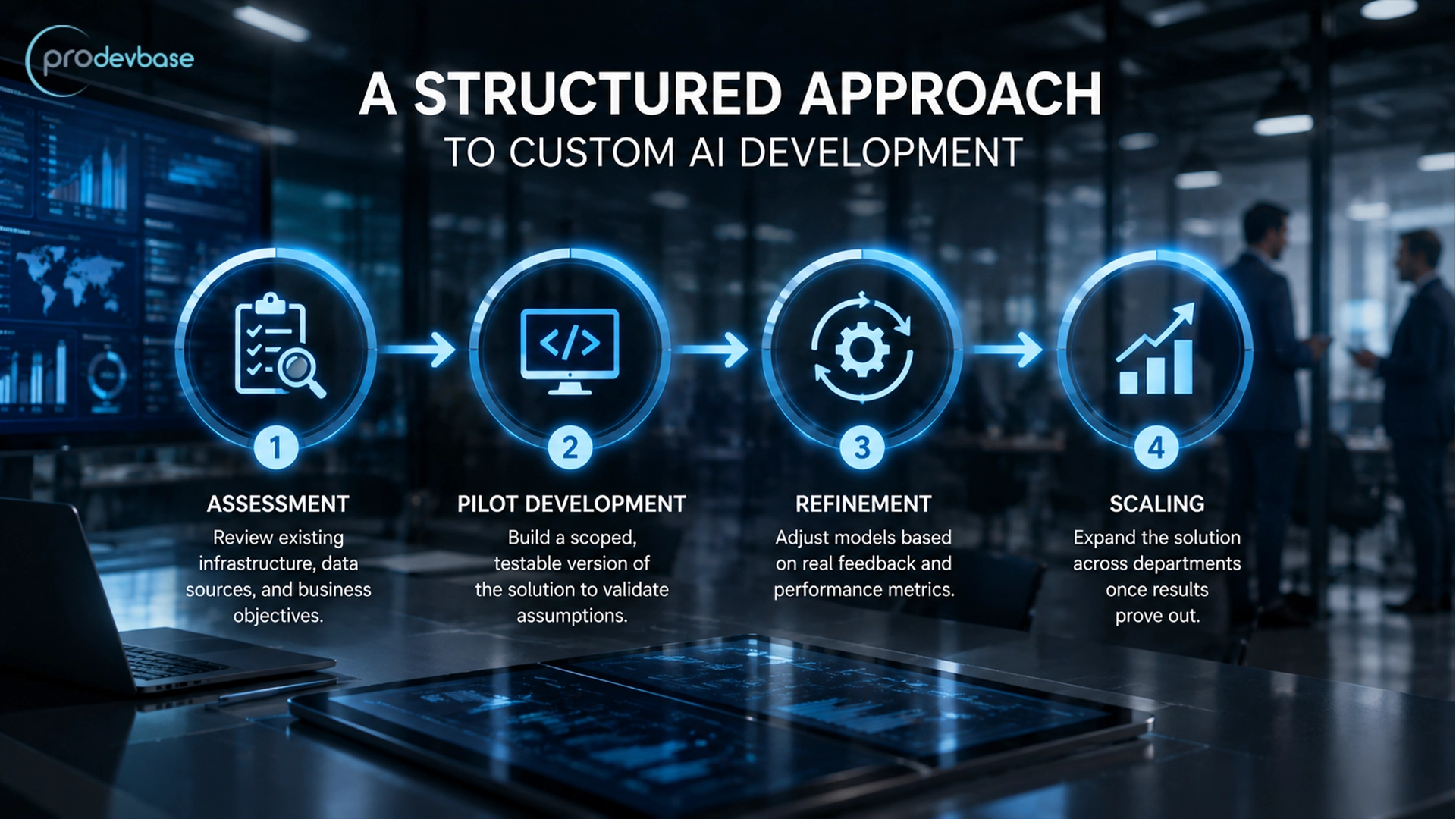
A structured approach tends to lower risk and lift outcomes considerably. Generally, this process includes:
- Assessment: Review existing infrastructure, data sources, and business objectives.
- Pilot development: Build a scoped, testable version of the solution to validate assumptions.
- Refinement: Adjust models based on real feedback and performance metrics.
- Scaling: Expand the solution across departments once results prove out.
Prodevbase follows this phased method to help businesses see measurable value before committing to full-scale deployment. As a result, teams allocate resources efficiently and keep risk low throughout the process.
Final Thoughts
Custom AI development is no longer optional for businesses in regulated, data-heavy industries. Healthcare providers, financial institutions, and retailers each face distinct challenges that generic AI tools simply cannot solve well. A tailored approach, grounded in industry knowledge and rigorous testing, therefore delivers stronger, steadier results.
Prodevbase continues to support businesses across these sectors by building AI systems around their real operational needs. For teams ready to move beyond generic tools, a thoughtful, vertical-focused strategy remains the clearest path forward.
Follow us on our LinkedIn Platform