
Why Enterprise AI Projects Fail: 10 Reasons AI Initiatives Don’t Reach Production
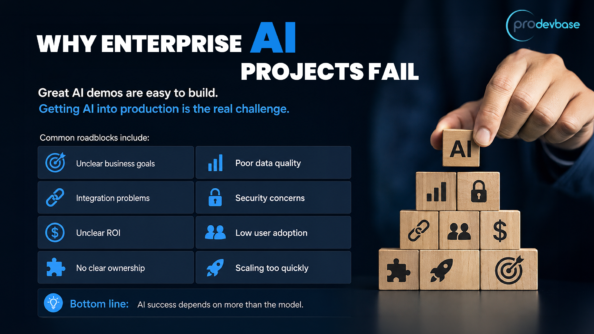
Enterprise AI Implementation: 10 Reasons AI Projects Fail
Artificial intelligence is no longer just an experiment for large businesses. Companies are using AI to automate operations, improve customer experiences, analyze data, and make faster decisions. Yet many AI projects still struggle to move beyond the pilot stage. So let’s have a look into Enterprise AI Implementation.
The problem is usually not the AI model itself. The real challenges often come from poor data, unclear goals, legacy systems, security concerns, weak governance, and a lack of measurable business value.
So, why do enterprise AI projects fail?
Here are 10 common reasons and what businesses can do to avoid them.
1. Starting With AI Instead of a Business Problem
One of the biggest mistakes is choosing an AI technology before defining what the business actually needs.
For example, a company may decide it needs a generative AI chatbot without first identifying whether customer support is really the problem.
A better approach is to start with a specific goal:
- Reduce customer support costs
- Improve production efficiency
- Reduce manual data entry
- Detect fraud faster
- Improve forecasting
- Increase employee productivity
When the business objective is clear, it becomes much easier to decide where AI can create real value.
2. Poor-Quality Data
AI is only as useful as the data behind it.
Enterprise data is often spread across CRMs, ERPs, spreadsheets, databases, cloud applications, and legacy systems. Some of that information may be incomplete, duplicated, outdated, or inconsistent.
An AI model trained on unreliable data will struggle to produce reliable results.
Before scaling an AI initiative, businesses need to understand their data environment and make sure the right information is accessible, accurate, secure, and AI-ready.
Better data creates a stronger foundation for better AI.
3. The Pilot Works, But Production Is Different
A successful proof of concept does not guarantee a successful production system.
A pilot may involve a small amount of clean data and a handful of users. Production is much more demanding.
The system may need to handle thousands of users, large data volumes, multiple applications, security requirements, and continuous requests.
This is where many projects get stuck.
The solution is to think about scalability from the beginning. Architecture, infrastructure, APIs, monitoring, security, and cost should all be considered before the project moves toward production.
4. Legacy Systems Create Integration Problems
Many enterprises still depend on older applications and databases that were never designed for modern AI workflows.
An AI solution may need information from several systems before it can make a useful recommendation or prediction.
If those systems cannot communicate effectively, the AI project becomes an integration challenge.
Businesses should map their existing technology environment before development begins. APIs, databases, data pipelines, authentication, and application dependencies all need to be considered.
Sometimes, the path to better AI starts with improving the technology foundation around it.
5. Security and Governance Come Too Late
Security cannot be added at the end of an enterprise AI project.
AI systems may work with sensitive customer information, financial records, intellectual property, employee data, or confidential business documents.
Without proper controls, businesses can face serious security and compliance risks.
A production-ready AI solution should consider:
- Data access controls
- Authentication
- Encryption
- Privacy
- Audit trails
- Human oversight
- AI risk management
- Regulatory requirements
Building these controls into the project early can prevent major problems later.
6. Nobody Can Clearly Explain the ROI
AI sounds exciting, but excitement does not create a business case.
Leadership needs to understand what the investment will deliver.
For example, if an organization spends $200,000 on an AI solution, what will it gain?
Will it save operating costs? Reduce processing time? Increase revenue? Improve customer satisfaction? Reduce errors?
These questions should be answered before significant investment takes place.
A strong AI project should have measurable targets such as:
Lower costs + faster processes + higher productivity = measurable business value.
7. Employees Don’t Trust the AI
Even technically strong AI solutions can fail if employees do not trust or use them.
Employees may worry about inaccurate recommendations, changes to their jobs, unfamiliar workflows, or a lack of transparency.
The answer is not simply more training after deployment.
Users should be involved during development. Their feedback can help teams understand what the AI needs to do and where human judgment should remain part of the process.
AI should support employees, not make their work harder.
8. The Project Has No Clear Owner
Enterprise AI involves multiple teams.
Data teams manage information. IT manages infrastructure. Security manages risk. Business teams understand workflows. Leadership manages investment and priorities.
When nobody owns the overall outcome, projects can lose direction.
A successful AI initiative needs clear ownership, responsibilities, timelines, and success metrics.
Someone should ultimately be accountable for answering one important question:
Is this AI solution delivering the business result we expected?
9. AI Is Treated as a One-Time Project
AI does not stop evolving after deployment.
Data changes. Models change. Business requirements change. Users provide new feedback. Costs can change as usage grows.
That means production AI needs continuous monitoring and improvement.
Businesses should track:
- Model performance
- Data quality
- User adoption
- System costs
- Security
- Accuracy
- Business outcomes
The production launch should be viewed as the beginning of the AI lifecycle, not the end.
10. Scaling Happens Too Early
One successful AI pilot can create pressure to roll the technology out across the entire organization.
That can be a mistake.
Before scaling, companies should confirm that the solution has reliable data, a strong architecture, proper security, clear governance, user acceptance, and measurable ROI.
A better approach is to prove the use case, strengthen the foundation, and then scale gradually.
Pilot smart. Measure results. Improve the foundation. Then scale.
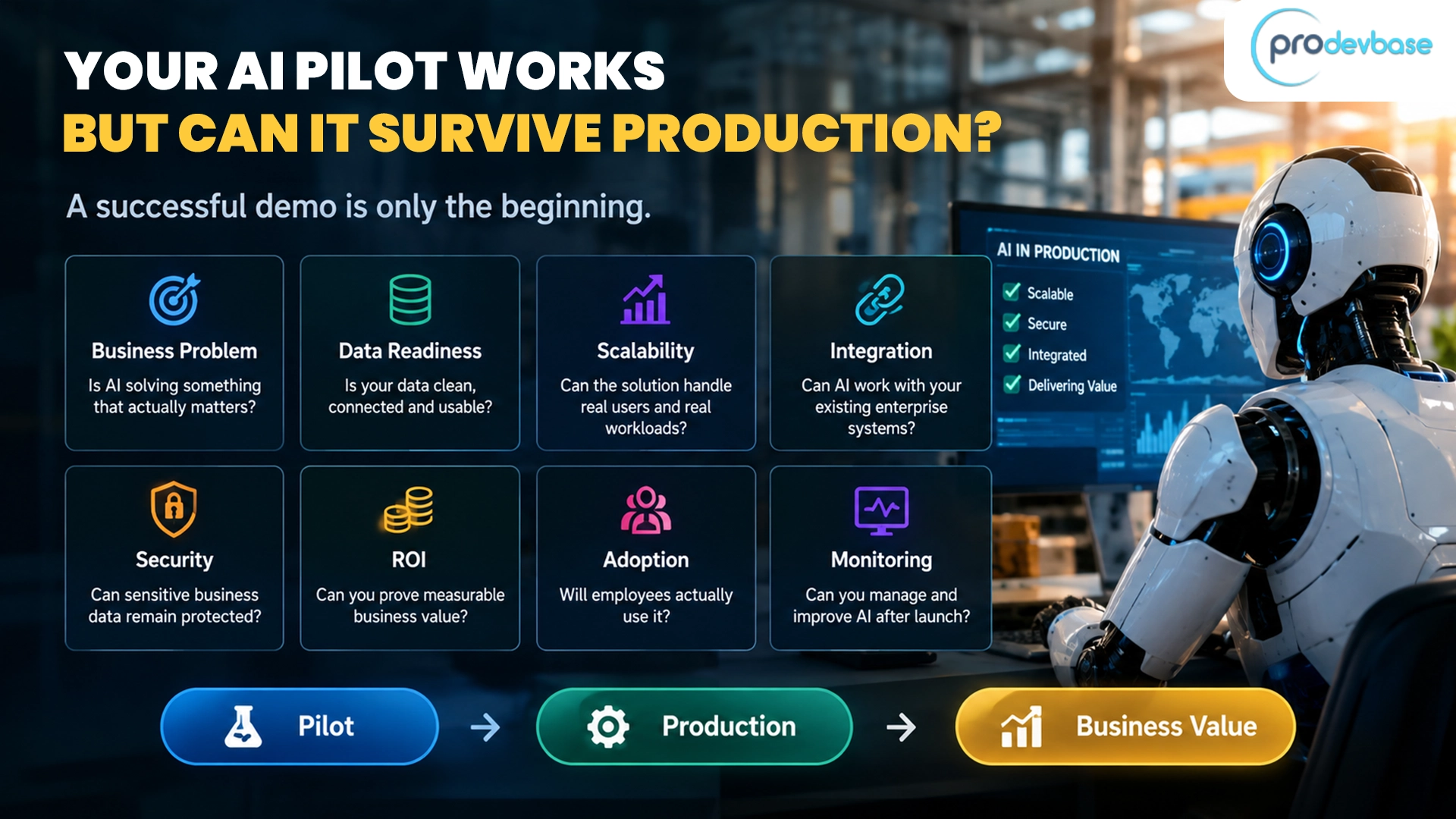
How to Move Enterprise AI From Pilot to Production
A successful enterprise AI journey does not happen overnight. It requires a practical process:
Business Problem → AI Strategy → Data Readiness → Proof of Concept → Production Architecture → Security → Governance → Integration → Deployment → Monitoring
Every stage should have a clear purpose and measurable outcome.
The goal is not simply to build an AI model. The goal is to build a solution that works reliably inside the business.
What Makes an Enterprise AI Project Successful?
Successful AI initiatives usually have a few things in common:
- A clearly defined business problem
- Reliable and accessible data
- Strong technical architecture
- Security and governance from the beginning
- Clear ownership
- Employee involvement
- Measurable ROI
- Continuous monitoring
- A realistic scaling strategy
When these elements come together, AI moves from an interesting experiment to a valuable business capability.
Turn AI Investment Into Business Results
Enterprise AI is not about adopting the latest technology just because it is available.
It is about solving the right problem, using the right data, and building a solution that can actually operate in the real world.
At ProDevBase, we help businesses move from AI ideas and proof-of-concepts toward scalable, production-ready solutions through AI Strategy, AI Product Engineering, AI Data Engineering, and Custom AI/ML Development.
If your AI initiative is stuck in the pilot stage, the next step may not be another AI model. It may be the right strategy, data foundation, architecture, or implementation plan.
Ready to move your AI project from pilot to production? Talk to ProDevBase and explore the right path for your business.
Frequently Asked Questions for Enterprise AI Implementation
Why do enterprise AI projects fail?
Enterprise AI projects commonly fail because of unclear objectives, poor data quality, integration problems, security concerns, weak governance, unclear ROI, and low user adoption.
Why do AI pilots struggle to reach production?
A pilot usually works in a controlled environment. Production requires scalability, security, integration, monitoring, governance, and reliable performance across real business workflows.
How can companies improve AI project success?
Companies should start with a clear business problem, assess data readiness, define ROI, involve users, plan for security and governance, and design the solution for production from the beginning.
How can ProDevBase help with enterprise AI?
ProDevBase helps businesses with AI strategy, AI product engineering, AI data engineering, and custom AI/ML development to build scalable AI solutions aligned with business goals.