
AI Strategy Advisory vs Intelligent Automation: Key Differences Every Business Should Know
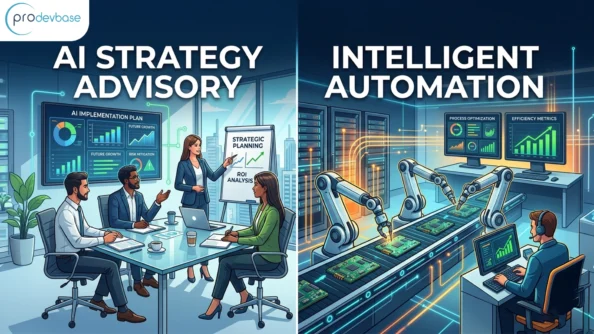
What are the Differences between AI Strategy Advisory vs Intelligent Automation?
AI investment decisions often fail not because of technology, but because of direction. Many organisations rush into automation or launch isolated AI projects without understanding what truly creates business value. Therefore, understanding the difference between AI strategy advisory and intelligent automation is so important. So let’s have a look at AI strategy advisory vs Intelligent automation.
One helps businesses define the right roadmap. The other improves execution through smarter systems and automated workflows. If an organisation is planning to adopt AI, knowing how the two approaches differ can help improve ROI, reduce wasted spend, and scale with confidence.
Understanding the Difference at a High Level
Before comparing both approaches in detail, it helps to understand their core purpose. AI strategy advisory focuses on aligning AI initiatives with business goals, priorities, and measurable outcomes. Meanwhile, intelligent automation focuses on improving efficiency by automating repetitive tasks and operational processes.
Although they are often grouped, they solve different problems. In many cases, businesses achieve the strongest results when strategy leads, and automation follows.
Main key Differences Explained
Both approaches create value, but they do so in different ways. For example, here is a clear comparison:
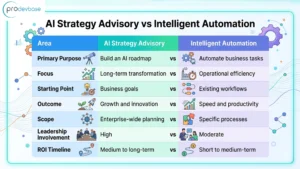
Simply put, AI strategy advisory defines where the business should go. Meanwhile, intelligent automation helps the business move faster.
When Your Business Needs AI Strategy Advisory
Organisation may benefit from AI strategy advisory by:
- Need a long-term AI roadmap before spending the budget
- Have multiple departments with competing priorities
- Need governance, compliance, or risk controls in place
- Want stronger ROI from AI investments
- Need executive alignment across teams
Planning a scalable AI transformation
Without a clear strategy, AI initiatives often become fragmented. As a result, budgets are wasted, and outcomes remain limited.
When Intelligent Automation Is the Better Choice
Business may be ready for intelligent automation by:
- Have repetitive tasks slowing down teams
- Need faster internal workflows with fewer errors
- Want to reduce operational costs
- Need quicker customer response times
- Are looking for measurable short-term efficiency gains
Furthermore, automation can deliver strong returns when applied to the right processes at the right time.
Why Businesses Often Confuse Both Approaches
Many organisations treat AI strategy advisory and intelligent automation as the same thing. However, this misunderstanding often leads to poor investment decisions.
Some businesses automate broken processes without fixing the larger strategy. Others spend too long planning and never move into execution. Consequently, results fall short of expectations.
The strongest outcomes usually happen when both approaches work together. In other words, AI strategy advisory sets direction, while intelligent automation turns priorities into action.
How AI Strategy Advisory and Intelligent Automation Work Together
A mature organisation often begins with strategy and then scales execution through automation. For instance:
- AI strategy advisory identifies customer support as a high-value growth area.
- Intelligent automation introduces AI chatbots and workflow routing.
- Response times improve, customer satisfaction rises, and costs decrease.
As a result, the business gains both strategic progress and operational efficiency.
Which Should You Choose?
The right decision depends on the current business stage.
- Choose AI strategy advisory for clarity, planning, and long-term transformation.
- Choose intelligent automation for faster processes, lower costs, and quick operational wins.
- Choose both if needed, for sustainable growth with scalable execution.
For most organisations, starting with strategy and layering automation on top creates the strongest long-term value.
Final Thoughts
AI strategy advisory and intelligent automation are not competing solutions. Instead, they are complementary capabilities that work best together.
AI strategy advisory helps leaders decide what matters most. At the same time, intelligent automation helps teams execute efficiently and at scale.
If organizations want lasting AI success, strategy should come first. Then, automation can scale the right opportunities with speed and confidence.
Also read: Why AI Strategy and Advisory Is the Most Important Business Decision of 2025
Frequently Asked Questions
Is AI strategy advisory the same as intelligent automation?
No. AI strategy advisory focuses on planning, prioritisation, and aligning AI with business goals. By contrast, intelligent automation focuses on automating workflows and repetitive tasks.
Which approach delivers faster ROI?
Intelligent automation often delivers faster short-term ROI through efficiency gains. However, AI strategy advisory supports stronger long-term ROI through smarter investment decisions.
Can a business use both approaches together?
Yes. Many organisations begin with AI strategy advisory and then implement intelligent automation in priority areas for stronger results.
Is AI strategy advisory only for large enterprises?
No. Mid-sized businesses also benefit from clear AI planning, especially before making major technology investments.
Ready to Build a Smarter AI Strategy?
Start with clarity before committing to tools. A strong AI strategy advisory approach helps businesses reduce risk, improve ROI, and unlock sustainable growth.