
Custom AI vs Ready-Made AI: Which Is the Smarter Choice for Your Business?
Custom AI Development vs Off-the-Shelf AI Solutions: Which Is Best for Your Business?
What is Custom AI Development?
Businesses are now in a position where they have to make a decision about AI. One option is to build a bespoke solution. The other is to subscribe to an existing product. The bespoke approach involves creating an AI model from scratch, using the business’s own data and objectives. In contrast, the alternative is to go with a ready-made product which comes with a set of pre-defined features. So let’s know more in deep about Custom AI Development vs Off-the-Shelf AI Solutions which is better.
Absolutely, both routes have merit. The right one is going to be a function of your budget, your timeline, your data and your strategy. You therefore need to evaluate the two options before you go down either path.
This guide sets out the differences in plain language terms. It also looks at the key factors, use cases and implementation steps. As a result, it enables the decision-makers to proceed with confidence.
How Ready-Made AI Tools Work
Ready-made tools are pre-built tools. For example, chatbots, writing assistants, and analytics platforms are all in that category. The vendor builds them for a broad audience, so the setup is very quick. Also, the pricing is typically a simple flat monthly fee.
However, customization is still very much limited, and the vendor has complete control over updates and data. As a result, a business could find itself in a difficult position if its requirements go beyond the standard features.
Why Custom AI Development Stands Out
Custom AI development starts with the problem, not the product. For example, a logistics company could train a model on their own routing data. Similarly, a clinic could build a triage assistant to support their day-to-day workflow.
Since the business owns the solution, it can adapt it as the goals evolve. However, it’s a higher up-front cost but can deliver a stronger return over the long term. Indeed, Prodevbase actually provides AI services to help growing teams build solutions of this type.
Key Factors for Choosing Between the Two Options
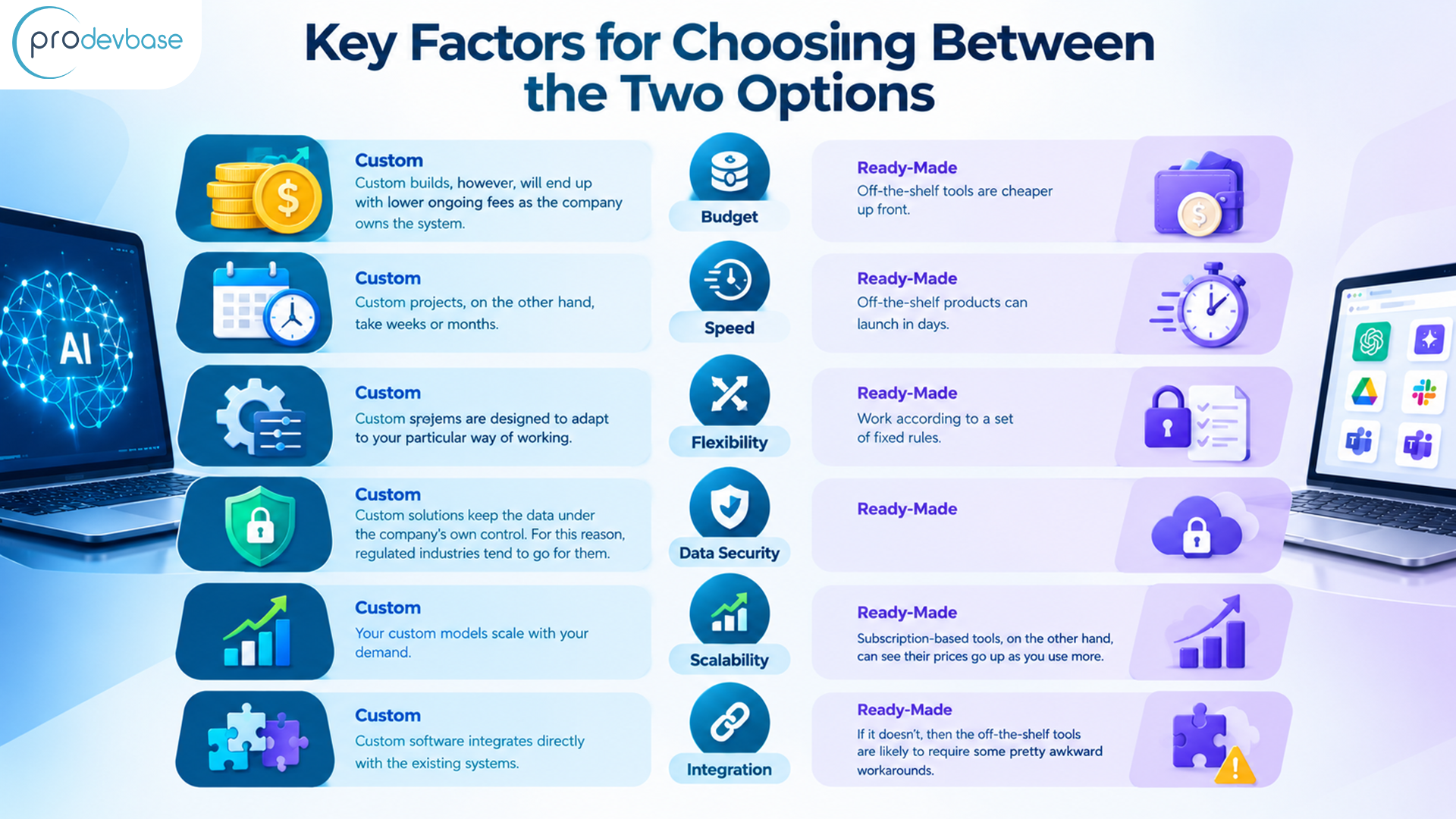
- Budget – Off-the-shelf tools are cheaper up front. Custom builds, however, will end up with lower ongoing fees as the company owns the system.
- Speed – Off-the-shelf products can launch in days. Custom projects, on the other hand, take weeks or months.
- Flexibility – Custom systems are designed to adapt to your particular way of working. Ready-made tools, on the other hand, work according to a set of fixed rules.
- Data Security – Custom solutions keep the data under the company’s own control. For this reason, regulated industries tend to go for them.
- Scalability – Your custom models scale with your demand. Subscription-based tools, on the other hand, can see their prices go up as you use more.
- Integration – Custom software integrates directly with the existing systems. If it doesn’t, then the off-the-shelf tools are likely to require some pretty awkward workarounds.
Real-World Use Cases for Each Approach
Specific examples will demonstrate where each approach is best. For this reason, the list below separates out the simple from the complex.
- Customer Support – A standard chatbot to deal with the basic FAQs, and a custom assistant to deal with the more complex, account-specific issues.
- Sales Forecasting – For example, a retailer could train a model on their own purchase history. As a result, the forecasts would be much sharper.
- Content Creation – Ready-made writing tools can produce posts very quickly. Therefore, this enables small teams to save hours every week.
- Fraud Detection – Banks use their own models because the fraud patterns are different at each institution.
- Document Processing – A ready-made OCR tool will be fine for simple invoices. However, a bespoke pipeline is the way to go for legal contracts.
- Healthcare Support – Clinics use custom models to do the record summaries. Meanwhile, privacy rules remain intact.
Steps to Implement the Right AI Solution
Step 1 – Define the Goal: Firstly, name the business problem. Secondly, define a measurable target (e.g., faster response times).
Step 2 – Audit the Data: Next, have a look at the quality and volume of data available. Indeed, bad data will obviously undermine even the best model.
Step 3 – Compare the Options: Then, weigh cost, speed, and control for both routes. Also, a simple scorecard will make the trade-offs clear.
Step 4 – Run a Pilot: Before you go full launch, run a small version. That way, the risks show up early and are relatively cheap to fix.
Step 5 – Measure the Results: After the pilot, you track the accuracy, the savings, and the user feedback. Otherwise, success is just a guess.
Step 6 – Deploy and Improve: Finally, deploy the solution and monitor performance. Of course, the system needs regular updates to stay useful as the situation evolves.
Technologies Behind Modern AI Solutions
The tech stack has an impact on cost, speed, and quality. It’s therefore useful to understand the different categories. That will in turn help teams to ask better questions.
- Machine Learning Frameworks – TensorFlow, PyTorch and scikit-learn are used for training the models and also for testing.
- Cloud Platforms – AWS, Microsoft Azure and Google Cloud provide scalable compute as well as secure storage.
- Language Model APIs – OpenAI, Anthropic and Google Gemini provide text generation. They’re all also accessible via simple integrations.
- Ready-made Platforms – ChatGPT, HubSpot AI and Zendesk AI deliver the features straight away, so no engineering is required at all.
Not only can the two approaches work in isolation, but they can also work in combination. For example, a business could start with a ready-made tool and later replace that with a bespoke solution. That way, the initial risk drops whilst still leaving the door open for growth.
Ready to choose the right AI path?
There’s no need at all to find the decision between custom and off-the-shelf AI confusing. Prodevbase actually helps you work out what you need and compare the different options. Then it goes on to build a solution that’s right for you. So get in touch with the team today to start a very practical discussion about AI.
Conclusion
Ready-made tools offer speed and low entry cost. Custom AI development, on the other hand, provides control, security, and a genuine long-term competitive advantage. The right choice in the end is going to be down to your objectives, your data, and your growth plans.
Prodevbase offers custom AI development, AI integration, and automation tailored to your business needs. So get in touch and turn your smart AI idea into a real solution.