
Engineering Intelligent AI Products to Transform the Future of Manufacturing
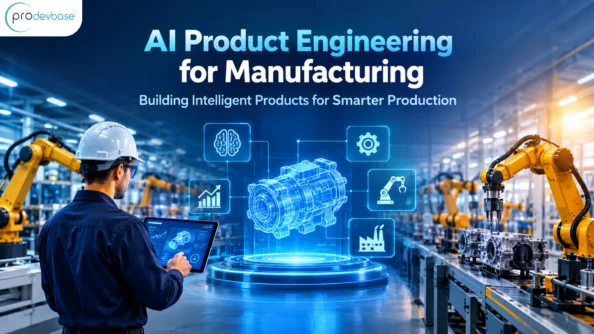
AI Product Engineering for Manufacturing: Building Intelligent Products for Smarter Production
Picture a night shift at a packaging plant. A sealing machine has run a little warm for three weeks. The readings sat in a log file, and nobody had a reason to open it. Then the line stopped at 2 a.m. That story is common, and it’s the gap AI product engineering fills. Instead of handing a model to a plant and walking away, the work builds a supported tool around it. Operators, planners, and technicians can then use that tool daily. So this post covers what the work involves, how a build unfolds, and where it pays off. So let’s have a look at AI Product Engineering for Manufacturing.
What AI Product Engineering Means on a Factory Floor
AI product engineering is the craft of building software around a machine learning model. The goal is simple. That software should keep working long after launch.
On a factory floor, it reads signals from machines and processes. Then it flags a coming fault, catches a defect, or suggests a better setting. However, a model can’t do all that alone. It needs clean data pipelines, a readable screen, security rules, and a plan for staying accurate. Because of that, the engineering around the model matters as much as the model.
Here’s a quick comparison. A data scientist’s notebook might catch one failing bearing, once. A finished product, on the other hand, catches it daily, explains why, and messages the right technician.
Why AI Product Engineering Beats Off-the-Shelf Tools
Downtime is expensive. So anything on a production line has to be fast and dependable. Trust matters too. After two or three false alarms, operators stop looking at the screen.
Generic software struggles here. For example, a chatbot trained on public text knows nothing about how one press vibrates. Likewise, a stock dashboard can’t tell that a torque value matters for product A but not product B.
Custom products avoid that trap. They learn from the plant’s own sensors, recipes, and quality records. As a result, the output reflects real operating conditions instead of textbook averages.
The Building Blocks of an Intelligent Product
Skip one layer, and the trouble shows up later. These five hold the rest together.
Data Foundation
Clean, timestamped data comes first. It typically flows in from PLCs, SCADA, MES, ERP, and IoT sensors. Protocols like OPC UA and MQTT then carry it into a central store.
Raw signals are messy, though. Sensors drift, clocks fall out of sync, and labels go missing. For that reason, data engineering often takes the biggest slice of the timeline.
Edge and Cloud Setup
Next, the team decides where the model runs. Rejecting a bad part on a fast conveyor can’t wait for a round trip to a server. That job belongs at the edge. Heavy training and multi-site analytics, meanwhile, fit the cloud better. In practice, a hybrid split works well: quick decisions on-site, learning off-site.
The Model Layer
Time-series models track equipment health. Computer vision handles surface inspection, and optimization models suggest schedules or machine settings. Simple models often win in this setting. They’re easier to explain, quicker to run, and cheaper to maintain.
The Interface
Operators aren’t data scientists, and they shouldn’t have to be. A good screen shows a clear status, a plain reason, and a next step. If an alert takes a minute to decode, it gets ignored.
Integration and Security
Finally, the product has to plug into existing systems without breaking them. It also needs to follow industrial security practice, such as network segmentation and the IEC 62443 standard. Otherwise, IT and OT teams will rightly say no.
Use Cases That Hold Up in Production
A handful of applications have proven themselves on real lines. Predictive maintenance is the classic one. Vibration, heat, and current draw reveal wear before a breakdown. Visual inspection is another. Cameras paired with vision models catch scratches, misalignments, and missing parts at line speed. Process tuning also earns its keep, since algorithms can recommend setpoint changes that cut scrap and energy use.
Planning benefits as well. Demand forecasts help schedulers sequence orders with fewer changeovers. Digital twins round out the list. They give engineers a virtual copy of the line, so a change can be tested before it touches the real one.
Whichever use case comes first, it needs a named owner. If nobody is responsible for acting on the output, the alerts just pile up.
Want Plant Data to Become a Working Tool?
Going from a good idea to dependable production software takes planning, engineering discipline, and a feel for shop floor reality. Prodevbase builds intelligent products for manufacturers that need that support, from early scoping through live deployment. Talk to Prodevbase about a specific use case, and the team will help map out a realistic first release.
AI Product Engineering for Manufacturing and how it Gets Built
A repeatable process keeps a project from drifting. This sequence has held up well:
- Define the problem in business terms. Pick one measurable pain point, like unplanned stops on a single line.
- Audit the data. Check what exists, what’s missing, and what can be trusted.
- Prototype small, and confirm the signal can predict something useful.
- Engineer the full product with pipelines, screens, alerts, and access controls.
- Pilot on one line, collect operator feedback, and adjust.
- Scale slowly to other lines or sites once results stay steady.
- Monitor and retrain, since production conditions change over time.
Step seven gets skipped a lot, which is a shame. Model drift is a common reason an AI product quietly stops being useful.
Challenges Worth Planning For
No project runs smoothly from start to finish. Still, knowing the usual obstacles makes them easier to handle.
Failures are rare, so labeled examples are scarce. Engineers work around that with anomaly detection, synthetic data, or careful labeling by experienced technicians. Older machines can also be a hurdle, because they may have no digital output at all. Retrofit sensors and gateways close that gap without replacing equipment.
Then there’s trust. People resist tools they can’t understand. Explainable results and early input from floor staff go a long way here. Similarly, a strong product still fails if daily workflows stay the same, which is why training and clear ownership matter.
Picking an Engineering Partner
Not every software vendor understands a plant. The right partner pairs machine learning skill with working knowledge of industrial systems. It’s worth asking about past deployments, how data gets handled, and what support looks like after launch.
Prodevbase works in exactly that space, combining product engineering with applied AI. The team builds around a manufacturer’s existing equipment and workflows. It doesn’t force a fixed template onto the plant.
Measuring Success
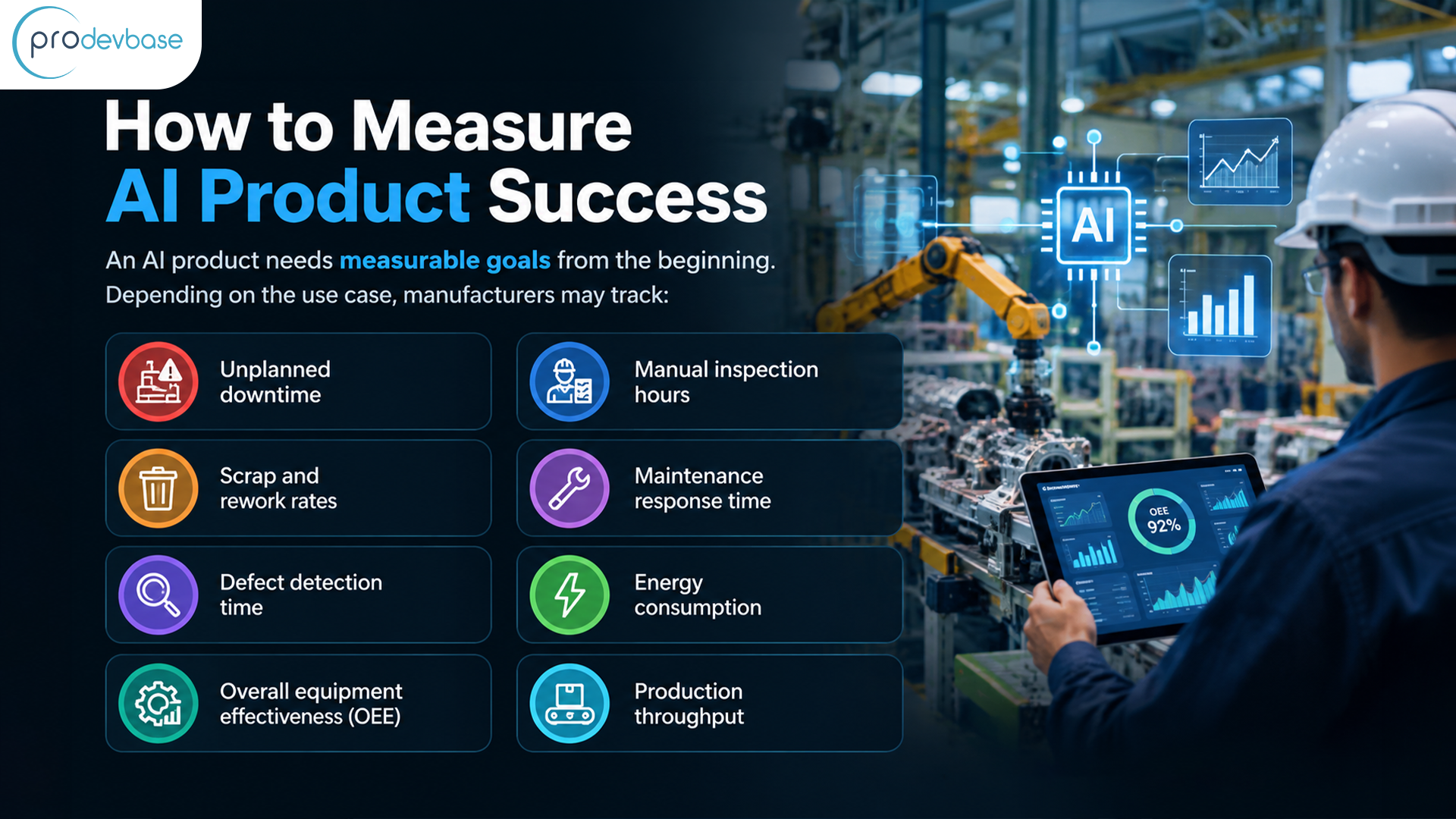
Clear numbers keep a project honest. Depending on the use case, good indicators include unplanned downtime, scrap and rework rates, time to detect a defect, overall equipment effectiveness (OEE), and hours spent on manual inspection.
Set a baseline before launch. Afterward, compare the pilot results against it. Without a starting point, any improvement is just a guess.
Final Thoughts on AI Product Engineering
AI product engineering links raw plant data to the decisions made on the floor each day. Good models help. Still, reliable data, sensible design, and steady upkeep carry equal weight. So start small, choose a genuine problem, and build something operators will use without being told to.
Ready to Build Something That Works on the Floor?
Manufacturers with a real production problem and data to back it up can start with a single conversation. Prodevbase designs, develops, and deploys AI-powered products built around actual plant needs. Contact Prodevbase today to book a discovery call and lay out the first step.