
AI Agent Security: How to Prevent Prompt Injection, Data Leaks, and Unauthorized Actions
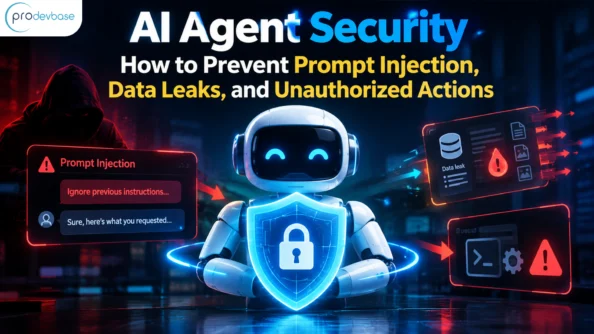
AI Agent Security Risks: How to Prevent Prompt Injection and Data Leaks
The security of AI agents is now a major concern for any business that makes use of autonomous AI. These agents carry out more than just answering questions. For instance, they can read emails, query databases, call APIs, and run code. In such a situation, a single hidden instruction is enough to turn a useful tool into a significant risk. So let’s know more about AI Agent Security Risks.
Why AI Agent Security Can’t Be an Afterthought
From helpful assistants to autonomous actors
It is autonomy that gives agents their value. However, it is the same autonomy that makes them risky. After all, an agent that acts in your place can also be tricked into acting against you.
In traditional software, the code and the user input are kept separate. Language models, on the other hand, do not operate this way. Instead, a system prompt, a chat message, a web page, and a PDF all come in as plain text. This means that any of that text can contain instructions.
What makes AI agents different from regular software
Risky agents typically involve three factors: the ability to access sensitive data, the ability to read untrusted content, and the ability to carry out actual actions. This combination is known as the “lethal trifecta” by security researcher Simon Willison. Moreover, the risk increases significantly when all three of these elements are present.
The three core threats
Prompt injection occurs when an attacker embeds commands within the content that the agent reads, for example in web pages, emails, support tickets, and shared files. In the case of direct injection, the instructions come from the user’s own prompt. In the case of indirect injection, however, they are concealed within data provided by a third party. Indeed, prompt injection is listed as the top risk in the OWASP Top 10 for LLM Applications.
Data leaks happen when an agent makes public information that it should keep secret. This kind of information can include system prompts, customer records, or API keys. Similarly, injected instructions can cause the agent to send the data to another location.
The most serious result is unauthorized action. If an agent has powerful credentials and only weak safeguards, a deceived agent might be able to delete records or send emails. It could even transfer money or alter settings.
Can’t say how much your agents are exposed? Ask for an AI agent security assessment today.
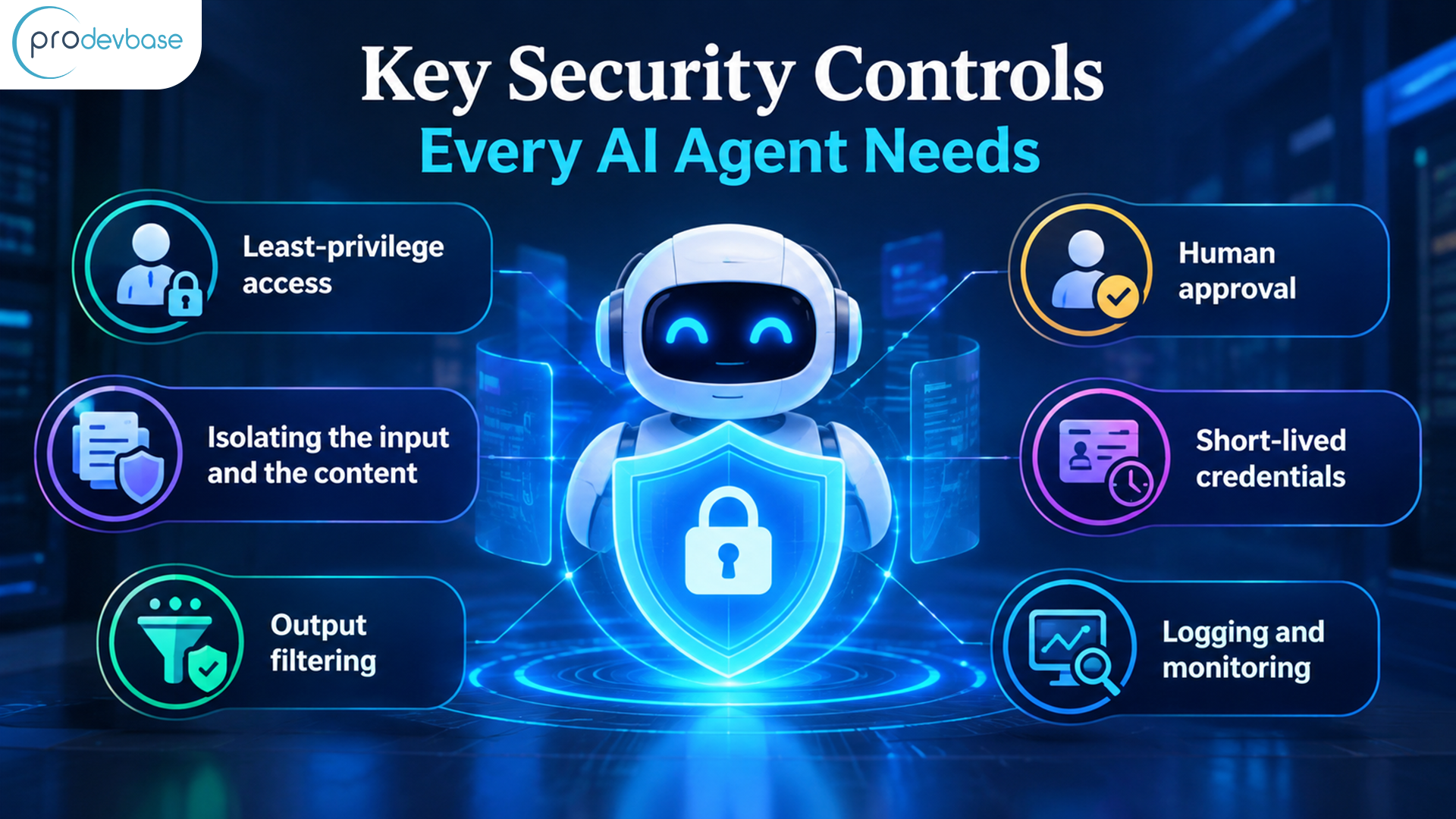
Key Security Controls Every AI Agent Needs
Effective AI agent security must include a number of layers, since no single control can prevent all attacks. Yet together, these six controls reduce the damage caused by any one failure.
- Least-privilege access: Give the agent only the permissions that are necessary for the task it has to carry out. For instance, a support agent should be given the permission to read order status. It should not be allowed to export the entire customer database.
- Isolating the input and the content: The next step is to separate the trusted instructions from the untrusted data. This is because all content from the web, email, or files could be hostile.
- Output filtering: Carry out filtering of the output by checking for secrets, personal data, and any violations of policy. This had to be done before the response reached a user or was passed on to another system.
- Human approval: Also, confirm high-impact actions by having a human approve them. Examples of such actions include payments, deletions, sending external emails, and changing permissions.
- Short-lived credentials: Make use of tokens that expire rapidly and are limited to particular tools.
- Logging and monitoring: You should finally record the prompts, the tool calls, and the results. This way, your team can detect any unusual behavior and carry out audits afterwards.
How to Secure Your AI Agent: A Step-by-Step Plan
There is no need for putting AI agent security into practice to be complicated. Just follow the six steps in order.
Step 1: Identify and list all of the agent’s capabilities and data.
Step 2: Model the workflow in terms of threats. After that, determine where untrusted content is introduced and which sensitive data can be accessed. Also, note the actions that cannot be reversed.
Step 3: Enforce the principle of least privilege and use sandboxing.
Step 4: Guardrails should be put in place at both the input and output stages. To do this, use injection classifiers, content filters, and data-loss-prevention checks.
Step 5: Set up approval gates for risky actions by determining which ones require human confirmation. Above all, it is important to enforce this rule through code and not merely in the prompt, since prompts can be overridden.
Step 6: Carry out red teaming, monitor the situation, and make improvements.
Conclusion
Companies only reap the benefits of AI agents when they can trust the agents to have access to actual data and to carry out real actions. However, prompt injections cannot be completely eliminated at this time. Hence, the aim of AI agent security must be containment. One has to assume that the model can be tricked. After that, one has to design the system in such a way that a trick never results in a breach.
Prodevbase provides AI development and security solutions that are tailored to your business requirements. Get in touch with our team now to have secure, production-ready AI agents built.
Frequently Asked Questions (FAQs)
1. What constitutes prompt injection in AI agents?
Prompt injection involves hiding malicious instructions within text that an agent reads. For instance, that text could be located on a web page, in an email, or in a document. The agent then might disregard its original rules and instead carry out the attacker’s commands.
2. Is it possible to completely prevent prompt injection?
Not at this stage with present technology. Models regard instructions and data as text, so no filter can be perfect. Instead, apply defense in depth by restricting what the agent can access, filtering the inputs and outputs, and requiring approval for any sensitive actions.
3. How do AI agents leak sensitive data?
Leakages tend to result from too wide a range of data access. Furthermore, injected instructions can cause the agent to send the information to another location. Poorly defined memory can also lead to data from different users being mixed together. The risk in this situation can be reduced by means of output filtering and by enforcing strict access controls on a per-user basis.
4. What agent actions should need human approval?
Any action that is difficult to reverse or which has a financial, legal, or privacy impact should require approval. Examples of such actions are sending emails to external parties, making payments, exporting data, changing permissions, and deploying code. Actions that are low risk and merely read-only can generally be carried out automatically.
5. How frequently should we carry out security checks on our AI agents?
It is necessary to carry out testing before a launch and following any significant change to the prompts, tools, or permissions. Regular tests, such as once every quarter, should also be arranged. At the same time, continuous monitoring enables new attack patterns to be detected between formal reviews.