
How Intelligent Automation Is Transforming Modern Businesses
Why to Implement Intelligent Automation in Business?
In 2017, JPMorgan Chase deployed an AI-powered contract analysis tool called COIN. Previously, this task required 360,000 hours of legal work every year. However, it was completed in seconds with no errors, no overtime, and no backlog. So let’s have a look at Why to Implement Intelligent Automation.
Clearly, this is not a future prediction. Instead, it is a reality that has already reshaped operations.
Since then, intelligent automation has evolved from an experimental concept into a business necessity. Today, companies across industries rely on AI-driven automation and cognitive automation systems to operate faster, reduce costs, and improve decision-making.
At Prodevbase, we see this shift firsthand as businesses move from manual workflows to scalable automation ecosystems.
In this blog, you will see what these automation systems look like in practice. More importantly, you will understand how leading organisations use them to solve real business problems.
What Is Intelligent Automation?
Most people are familiar with basic automation. For example:
Out-of-office email replies
Scheduled reports
Auto-filled forms
However, intelligent automation goes much further.
Unlike traditional automation, it does not just follow rules. Instead, it:
Interprets data
Handles unstructured information
Makes context-based decisions
Continuously learns and improves
As a result, these AI-powered automation solutions can handle complex workflows that basic scripts simply cannot manage.
What Separates Intelligent Automation from Basic Automation
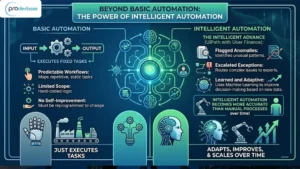
For instance, when UiPath worked with Uber’s finance team, the goal was to automate invoice reconciliation.
However, the system did far more than match numbers. It:
Flagged anomalies
Escalated exceptions
Learned which issues required human review
Over time, this automation system became more accurate than manual processes.
Therefore, the difference is clear. Intelligent automation does not just execute tasks. Instead, it adapts, improves, and scales over time.
Real Business Problems Solved by Intelligent Automation
1. Faster Document Processing at Scale
For example, the Australian Taxation Office processes millions of documents every year. By implementing AI-based automation, they significantly reduced manual effort.
As a result, tasks that once took weeks were completed in just hours.
Similarly, Siemens automated purchase order processing. Consequently:
Processing time dropped by 85%
Errors reduced significantly
2. Smarter Customer Service Without Hiring More Staff
Meanwhile, Bank of America launched its virtual assistant, Erica, in 2018.
By 2023, it had handled over 1.5 billion interactions. In addition, it can:
Answer balance queries
Detect unusual spending
Assist with transactions
Send reminders
Therefore, customers receive instant support without needing human agents.
3. Supply Chain Optimization
At scale, Amazon relies heavily on advanced automation systems across its fulfilment network.
These systems:
Predict demand in advance
Reposition inventory proactively
Automate picking and sorting
As a result, operations run faster and more efficiently.
Similarly, Unilever improved demand forecasting across 60 countries. Consequently:
Forecasting errors dropped by 30%
Inventory costs decreased
4. Streamlining HR Operations
In another example, Vodafone redesigned its onboarding process using cognitive automation.
Previously, onboarding took up to two weeks. However, after implementing automation:
The process was completed in under 48 hours
Tasks across HR, IT, and payroll were synchronised
Thus, both efficiency and employee experience improved significantly.
This is the kind of transformation that companies working with Prodevbase aim to achieve across departments.
Why Many Automation Projects Fail
Despite these success stories, many automation initiatives still fail.
However, the issue is rarely the technology itself. Instead, it usually comes down to execution.
According to a Deloitte survey, 78% of organisations have adopted automation. However, fewer than half achieved their expected ROI.
This gap typically occurs due to:
Poor process selection
Weak change management
Lack of continuous optimisation
For instance, if a broken process is automated, it simply becomes inefficient at scale.
Therefore, businesses must first optimise workflows before implementing intelligent automation solutions.
At Prodevbase, this process-first approach ensures automation delivers measurable business value from day one.
How Intelligent Automation Works
In practice, intelligent automation combines multiple technologies. Each plays a specific role:
Robotic Process Automation (RPA): Handles repetitive tasks
Artificial Intelligence (AI): Enables decision-making
Machine Learning (ML): Drives continuous improvement
Natural Language Processing (NLP): Understands human language
Process Mining: Identifies inefficiencies
Together, these technologies create adaptive automation ecosystems that go beyond simple task execution.
What Makes a Successful Intelligent Automation Strategy
Successful organisations follow a structured approach.
1. Start with Process Clarity
First, they map workflows and identify inefficiencies.
2. Measure Results
Next, they track performance before and after implementation.
For example, DHL reduced:
Processing time by 70%
Errors by over 60%
3. Treat It as a Continuous Program
Finally, they treat automation as an ongoing initiative rather than a one-time project.
Common Myths About Intelligent Automation
Myth 1: It is only for large enterprises
In reality, modern automation platforms are accessible to businesses of all sizes.
Myth 2: It eliminates jobs
On the contrary, it removes repetitive tasks and enables employees to focus on strategic work.
Myth 3: It is too complex
However, with a phased approach, implementation becomes manageable and scalable.
Technologies Powering Intelligent Automation
Currently, several platforms are driving adoption:
UiPath and Automation Anywhere for enterprise RPA
Microsoft Power Automate for mid-sized businesses
IBM Watson and Google Cloud AI for advanced AI capabilities
Celonis for process mining
Ultimately, the right choice depends on business needs rather than tools alone.
The Future of Intelligent Automation
Looking ahead, the next phase of automation is already emerging.
Agentic AI
These systems can handle multi-step tasks independently.
Generative AI Integration
In addition, automation tools can now:
Draft emails
Summarise documents
Generate reports
Learn More About Implementation of Agentic AI
Hyperautomation
Furthermore, organisations are connecting multiple systems into unified automation frameworks.
As a result, businesses are moving toward fully automated ecosystems.
Conclusion
The results are clear:
JPMorgan saved 360,000 hours of work
Bank of America handled 1.5 billion interactions
Unilever reduced forecasting errors by 30%
Vodafone cut onboarding time from weeks to hours
Clearly, these are not isolated cases. Instead, they represent a broader shift toward intelligent automation and AI-driven operations.
Therefore, the gap between automated and manual organisations continues to grow.
Businesses that adopt these advanced automation solutions today will be far better positioned for the future — especially when guided by experienced partners like Prodevbase.
FAQs
What is intelligent automation?
It combines AI, machine learning, and automation technologies to perform complex tasks with minimal human effort.
How is it different from RPA?
RPA follows rules, whereas intelligent automation can learn, adapt, and make decisions.
Is it expensive?
Not necessarily. In fact, many low-code tools make automation affordable.
Which industries benefit the most?
Finance, healthcare, retail, logistics, and manufacturing benefit significantly.
Final CTA
Ready to transform your operations with intelligent automation?
Book a free assessment today at Prodevbase and discover high-impact automation opportunities for your business.