
Implementation of Agentic AI and its real-world Impact
Why to Implement Agentic AI in Business Growth?
Businesses can no longer be satisfied with basic automation. Instead, they are rapidly implementing Agentic AI to handle complex, multi-step workflows. So let’s have a deep look into about Why to Implement Agentic AI in business.
Traditional AI reacts to inputs, whereas agentic AI acts independently. Therefore, it can plan, execute, and optimise tasks without constant human intervention. As a result, organisations improve speed, reduce manual effort, and enhance decision accuracy.
Moreover, according to companies like McKinsey, businesses that adopt advanced AI automation can improve productivity by up to 40%. Consequently, agentic AI is becoming a strategic priority across industries.
Agentic AI vs Generative AI vs RPA
Before starting an Agentic AI implementation, it is important to understand how it differs from other technologies.
- Agentic AI → autonomous decision-making and execution
- Generative AI → content creation (text, images, code)
- RPA → rule-based task automation
Therefore, while RPA follows fixed rules and Generative AI creates outputs, agentic AI manages entire workflows. As a result, it enables end-to-end business automation rather than isolated improvements.
Agentic AI Architecture and Core Components
A strong architecture is essential for successful Agentic AI implementation.
Agents (Decision Layer)
Agents interpret goals and determine the best actions. Additionally, they coordinate with other agents in multi-agent systems.
Memory Systems (Context Layer)
Short-term memory handles active tasks. Meanwhile, long-term memory stores knowledge and improves decision quality over time.
Planning Engine (Execution Layer)
This layer breaks down goals into steps. Furthermore, it dynamically adjusts plans based on real-time feedback.
Tool and API Integration (Action Layer)
Agents interact with enterprise systems such as CRMs, ERPs, and APIs. Therefore, they can execute real-world actions, not just analysis.
Feedback Loop (Learning Layer)
Every action is evaluated. Consequently, the system improves continuously through reinforcement learning.
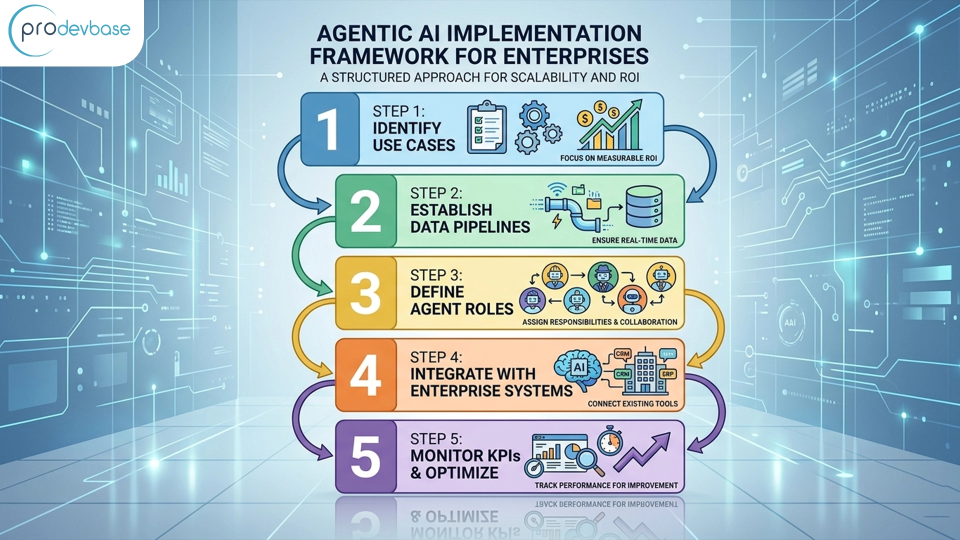
Agentic AI Implementation Framework for Enterprises
A structured Agentic AI implementation ensures scalability and ROI.
Key Metrics to Measure Agentic AI Success
Unlike traditional AI, Agentic AI implementation requires performance tracking.
- Task Completion Rate → percentage of tasks completed without human intervention
- Decision Accuracy → quality of AI-driven decisions
- Response Time Reduction → speed improvements in workflows
- Cost per Task → operational cost savings
- Automation Coverage → percentage of workflows automated
As a result, these metrics help businesses measure real ROI and optimize performance.
Enterprise Use Cases of Agentic AI Implementation
Organizations are already leveraging Agentic AI implementation across industries.
Sales and Revenue Operations
Agents manage lead qualification, outreach, and follow-ups. Consequently, conversion rates improve.
Customer Support Automation
AI agents resolve queries instantly. Additionally, they escalate complex issues when needed.
IT and DevOps
Agents detect anomalies and fix issues automatically. Therefore, system downtime is reduced.
Supply Chain Optimization
AI predicts demand and adjusts logistics in real time. As a result, operational efficiency increases.
Tools and Technology Stack for Agentic AI
The right tools accelerate Agentic AI implementation.
- LangGraph → multi-agent orchestration
- AutoGen → collaborative AI workflows
- CrewAI → task automation
- LlamaIndex → data connectivity
- Semantic Kernel → enterprise integration
Moreover, cloud platforms such as AWS and Azure enable scalability. Consequently, businesses can deploy solutions faster.
Challenges in Agentic AI Implementation
Despite its benefits, the Agentic AI implementation introduces new challenges.
Alignment Risks
Agents may misinterpret goals. Therefore, clear instructions and constraints are critical.
Explainability Issues
Decisions may not always be transparent. As a result, explainable AI techniques are required.
Security and Access Control
Autonomous systems increase risk exposure. Consequently, strict access policies are necessary.
Integration Complexity
Connecting with legacy systems can be difficult. However, APIs and middleware simplify the process.
Case Study: Agentic AI Implementation in SaaS Operations
A SaaS company faced slow customer response times and high support costs.
Solution
The company deployed an Agentic AI implementation to automate ticket handling and workflow execution. Additionally, agents are integrated with CRM and support platforms.
Results
- 65% faster response time
- 40% reduction in support costs
- 30% increase in customer satisfaction
As a result, the company scaled operations without increasing headcounts.
Learn More About AI strategy and advisory
To understand the fundamentals, explore our detailed guide on Agentic AI basics and concepts.
Conclusion: From Automation to Autonomous Enterprises
Agentic AI is redefining how businesses operate. Instead of relying on manual workflows, organizations now deploy systems that think and act independently.
Therefore, adopting Agentic AI implementation is no longer optional for forward-looking companies. Furthermore, it enables scalability, efficiency, and innovation at every level.
Ultimately, the future belongs to enterprises that move from automation to autonomy.
Follow us on our LinkedIn Platform