
Generative AI: The Technology That Rewrote the Rulebook
What is Generative AI Explained with Examples
Generative AI is one of the fastest-growing technologies in the world today. In fact, according to McKinsey, it could add up to $4.4 trillion to the global economy every year. As a result, adoption is accelerating across industries, with companies like Prodevbase actively exploring its potential. So let’s have a deep look into what is Generative AI explained with examples.
Unlike traditional AI, which analyzes or classifies existing data, generative AI creates entirely new content. For example, it can generate text, images, audio, video, and even code. Instead of retrieving stored answers, it produces original outputs based on learned patterns.
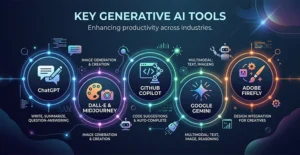
Popular tools such as ChatGPT, DALL·E, Midjourney, and Google Gemini are powered by generative AI. Moreover, these tools are widely used by freelancers, businesses, educators, and developers, including teams working on advanced solutions at Prodevbase.
Because of this rapid growth, understanding generative AI is no longer optional. Instead, it is essential for staying competitive in today’s digital world.
Key Takeaways
- Generative AI creates original content such as text, images, audio, and code
- It is powered by large language models (LLMs) and deep learning
- Popular tools include ChatGPT, DALL·E, Midjourney and Google Gemini
- It is widely used across healthcare, marketing, finance, and development
- Responsible use and human oversight remain essential
How Does Generative AI Work?
To understand generative AI, it helps to look at how it works behind the scenes. Generative AI relies on deep learning and neural networks, which are inspired by the human brain.
Most modern systems use large language models (LLMs). These models are trained on massive datasets, including books, websites, and research papers. As a result, they learn patterns in language, tone, and meaning.
When you enter a prompt, generative AI does not search for a fixed answer. Instead, it predicts the most likely sequence of words, pixels, or code. Therefore, the output feels natural, creative, and context-aware.
In addition, image tools like DALL·E and Midjourney use diffusion models. These models start with random noise and gradually refine it into a clear image. Consequently, even simple prompts can produce high-quality visuals.
Furthermore, generative AI continues to improve over time. New models are trained on better datasets, which increases both accuracy and creativity.
Top Use Cases of Generative AI
Generative AI is transforming industries in real time. Below are some key applications.
Content Creation and Marketing
Generative AI helps create blogs, ads, emails, and social media content quickly. As a result, teams produce more content in less time.
Healthcare and Research
In healthcare, generative AI analyzes medical data and supports diagnosis. Moreover, it accelerates drug discovery and treatment planning.
Software Development
Developers use generative AI to write code, detect errors, and automate testing. Therefore, development cycles become faster and more efficient.
Education
Generative AI creates personalized learning experiences. In addition, it helps teachers save time on administrative tasks.
Design and Creative Work
Designers use generative AI to generate visuals and explore ideas. Consequently, creative workflows become faster and more flexible.
Finance and Legal Services
Generative AI helps draft documents and analyze complex data. As a result, decision-making becomes faster and more accurate.
Key Benefits of Generative AI
Generative AI offers several major advantages.
Speed and Efficiency
Generative AI produces results in seconds. Therefore, businesses can respond faster to opportunities.
Cost Reduction
By automating tasks, companies reduce operational costs. In addition, teams can focus on high-value work.
Scalability
Generative AI handles large volumes of tasks without performance loss. As a result, businesses scale efficiently.
Personalization
It creates tailored content for users. Consequently, customer experiences improve significantly.
Accessibility
Generative AI makes advanced capabilities available to everyone. Therefore, more people can create and innovate.
We also provide Digital Consulting Services in Prodevbase.com
Challenges and Risks of Generative AI
Despite its benefits, generative AI also presents challenges.
Misinformation
Generative AI can create misleading content. Therefore, fact-checking is essential.
Copyright Issues
Training data raises questions about ownership and usage rights. As a result, legal frameworks are evolving.
Bias in AI
AI models can reflect biases in data. Therefore, monitoring and control are necessary.
Over-Reliance
Excessive dependence on generative AI may reduce critical thinking. Instead, human review should always be included.
The Future of Generative AI
Generative AI is evolving rapidly. Several key trends will shape its future.
Multimodal AI
Future systems will handle text, images, audio, and video together. As a result, outputs will become more advanced.
Hyper-Personalization
Generative AI will adapt to individual users. Therefore, experiences will become highly customized.
Industry-Specific Models
Specialized AI models will improve accuracy in fields like healthcare and law. Consequently, adoption will increase.
Best Practices for Using Generative AI
To get the most value from generative AI, organizations should follow a structured approach.
- Start with clear use cases and defined goals
- Use high-quality and relevant data for better outputs
- Always review and validate AI-generated content
- Implement ethical guidelines and responsible usage policies
- Continuously monitor performance and improve workflows
By following these practices, businesses can maximize benefits while minimizing risks.
Conclusion: Why Generative AI Is Transforming the Future
Generative AI is reshaping how people create, solve problems, and communicate. More importantly, it is changing how businesses operate and compete in a digital-first world.
Organizations that embrace generative AI can move faster, reduce costs, and unlock new opportunities. At the same time, success depends on using the technology responsibly and thoughtfully.
Looking ahead, generative AI will continue to evolve and become more powerful. Therefore, those who learn and adapt early will be in the best position to succeed. In a rapidly changing world, generative AI is not just an advantage—it is becoming a necessity.