
Agentic AI: Path to Autonomous Decision Making
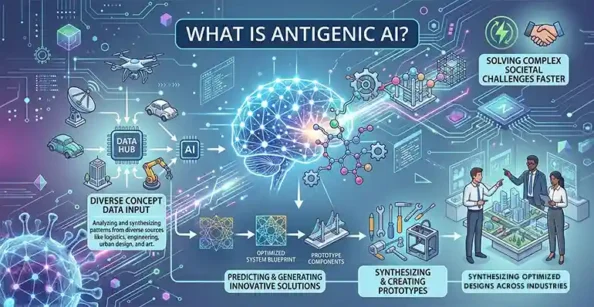
What is Agentic AI with Examples?
Agentic AI is one of the most important shifts in technology today. Unlike traditional AI, which waits for instructions, agentic AI systems act independently. They set goals, make decisions, and complete tasks without constant human guidance. So let’s know in deep about what is Agentic AI with Examples?
Think about a standard AI chatbot. It responds only when prompted. In contrast, an agentic AI system can plan tasks, gather information, and execute actions from start to finish. As a result, it behaves more like a capable digital assistant than a simple tool.
Today, businesses across healthcare, finance, logistics, and e-commerce are adopting agentic AI. They use it to reduce costs, improve accuracy, and automate complex workflows. If you want to understand the future of artificial intelligence, agentic AI is the place to start.
How Does Agentic AI Work?
Agentic AI combines several advanced technologies. These include machine learning, natural language processing, reinforcement learning, and planning algorithms.
The process follows a simple cycle:
- First, the system receives a goal
- Next, it analyzes the environment and available data
- Then, it selects the best course of action
- After that, it executes the action
- Finally, it evaluates the result and learns from it
As a result, agentic AI improves with every cycle. This feedback loop makes the system faster, smarter, and more efficient over time.
Unlike traditional AI, it does not stop after responding. Instead, it continues learning and adapting to handle complex situations.
Key Characteristics of Agentic AI
Understanding these characteristics explains why organizations are investing heavily in agentic AI.
True Autonomy
Agentic AI does not require step-by-step instructions. Instead, it uses internal logic to decide the best path forward. As a result, it can operate for long periods without human oversight.
Goal-Oriented Thinking
Agentic AI focuses on outcomes rather than individual prompts. It breaks large goals into smaller tasks. Then, it completes them step by step, even when conditions change during the process.
Real-Time Adaptability
These systems learn from every interaction. For example, if one strategy fails, they quickly adjust and try another approach. Over time, this makes them more reliable than rule-based systems.
Data-Driven Decision Making
Before taking action, agentic AI evaluates multiple options. It considers context and available data. Therefore, it can choose the most effective path and reduce errors.
Continuous Self-Improvement
Agentic AI continuously improves its performance. It learns from new data and refines its approach. As a result, it becomes more effective over time.
Benefits of Agentic AI for Businesses
Organizations using agentic AI report several clear advantages.
Higher Efficiency
Agentic AI completes tasks faster and with fewer errors. In addition, it removes the need for constant human approval. As a result, workflows become faster across departments.
Smarter Decision Making
These systems process large amounts of data in seconds. Therefore, they provide accurate and consistent decisions. This is especially useful in data-heavy environments.
Scales Without Extra Resources
Agentic AI can handle multiple tasks at the same time. Moreover, it maintains performance without additional resources. A single system can replace multiple tools or manual processes.
Reduced Operating Costs
By automating tasks, businesses save both time and money. Over time, these savings increase significantly. This creates a strong competitive advantage.
New Innovation Opportunities
Agentic AI enables new solutions that were not possible before. For example, it removes bottlenecks in research and development. As a result, teams can focus on strategy and creativity.
Real-World Applications of Agentic AI
Agentic AI is already delivering real results across industries.
Healthcare
In healthcare, agentic AI supports diagnosis and treatment planning. It analyzes medical data and identifies patterns. As a result, it improves patient outcomes and reduces workload.
Finance
Financial institutions use agentic AI for fraud detection and portfolio management. Moreover, it processes market data continuously. Therefore, it reacts faster than human analysts.
E-Commerce
Online retailers use agentic AI to improve customer experiences. It recommends products and manages inventory. In addition, it handles customer support. As a result, businesses increase conversions and reduce costs.
Logistics and Supply Chain
Agentic AI predicts demand and optimizes delivery routes. It also reduces delays. For example, it can respond to disruptions in real time and keep operations running smoothly.
Customer Service
Agentic AI provides fast and accurate responses. It resolves simple issues and escalates complex ones. Over time, it learns from interactions and improves performance.
Agentic AI vs Traditional AI
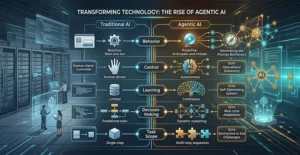
Traditional AI follows instructions. In contrast, agentic AI identifies goals and takes action independently. This difference makes agentic AI a major advancement rather than a small improvement.
Challenges of Agentic AI
Agentic AI offers many benefits. However, organizations must address key challenges.
Ethical Accountability
These systems make decisions that affect people. Therefore, organizations must ensure fairness and transparency. Ethical safeguards are essential.
Cybersecurity Risks
Because agentic AI operates autonomously, security risks are higher. As a result, strong protection measures are necessary. These include audits and access controls.
Transparency and Explainability
It can be difficult to understand how decisions are made. This is known as the “black box” problem. However, new tools are improving transparency.
Upfront Investment
Building agentic AI requires investment in technology and talent. However, long-term benefits usually outweigh the initial cost.
The Future of Agentic AI with Examples
The future of agentic AI involves deeper integration into everyday systems. As technology evolves, it will transform industries.
Integration with IoT
Agentic AI will connect with IoT devices. As a result, systems will become more intelligent and automated.
Hyper-Personalization
Agentic AI will better understand user behavior. Therefore, personalized experiences will become the standard.
Expansion into New Sectors
Industries like education and agriculture are adopting agentic AI. Moreover, this trend will continue to grow.
Human-AI Collaboration
The future is not about replacing humans. Instead, it focuses on collaboration. AI handles operations, while humans focus on strategy.
We also offer Generative AI solutions—learn more
How to Implement Agentic AI Successfully
A structured approach is key to success.
Start with Clear Goals
Define measurable objectives. This ensures better outcomes and performance tracking.
Focus on Data Quality
High-quality data improves system performance. Therefore, clean and structured data is essential.
Prioritize Security
Build security into the system from the beginning. Do not treat it as an afterthought.
Ensure Transparency
Help users understand how decisions are made. This builds trust and improves adoption.
Monitor and Improve
Agentic AI requires continuous monitoring. Regular updates help maintain performance.
Conclusion: Why Agentic AI Is the Future
Agentic AI is not just a trend. It is a major shift in artificial intelligence. Today, it is already transforming industries.
Organizations that adopt it early gain a strong advantage. They improve efficiency, reduce costs, and enhance capabilities. As a result, they stay ahead of competitors.
Although challenges exist, they can be managed with the right strategy. Therefore, understanding agentic AI is essential. The future is already here. The key question is how quickly you adapt.