
How to Fix AI Strategy and Advisory Services and Drive Real Results
How to Fix AI Strategy and Advisory Services Issues?
The Uncomfortable Truth About AI in Business Today
Most businesses have already tried AI in some form. However, very few have made it work at scale. In fact, a McKinsey study found that fewer than 30 per cent of companies successfully scale AI beyond early pilots. So let’s have a look at How to fix AI Strategy and Advisory Services.
That number is striking. Especially given how much investment is flowing into artificial intelligence right now.
So, the real question is not whether to adopt AI. Instead, the question is why so many well-funded AI efforts fail. Furthermore, what separates businesses that succeed from those that stall?
In most cases, the answer comes down to one thing. The absence of a structured AI strategy and advisory approach from the very beginning makes the difference.
The Hidden Reasons AI Initiatives Fail
Understanding failure is the first step toward building something that lasts. Therefore, it is important to examine the common patterns behind unsuccessful AI programmes.
1. AI is treated as a Technology Problem
Many organisations hand AI projects entirely to their IT teams. As a result, the technology gets built—but it often solves the wrong problems.
Without a proper AI strategy and advisory, there is no bridge between what engineers build and what the business actually needs. Consequently, the result is a technically impressive system that delivers little real value.
2. Data Is Not Ready
Even the most advanced AI models fail when they rely on poor data. Moreover, many businesses overestimate the quality of their internal data.
Without an honest data audit, this issue remains hidden until it is too late. For example, fragmented data, inconsistent labelling, and outdated systems are common barriers.
Therefore, data readiness must be assessed before any AI implementation begins.
3. No Clear Ownership
Successful AI adoption requires accountability. However, many organisations lack a clear owner for AI initiatives.
As a result, projects move between teams without direction. Consequently, progress slows, priorities shift, and initiatives eventually lose momentum.
4. Scaling Is Never Planned
A pilot that works in one department does not automatically scale across the organisation. In addition, the infrastructure required for scaling AI is very different from running a proof of concept.
Without planning for scale from day one, businesses risk building solutions that cannot grow. Therefore, long-term thinking is essential for successful AI implementation.
5. Success Is Never Defined
Many AI projects begin without clear success metrics. As a result, teams cannot measure performance effectively.
Consequently, investment continues without direction and eventually loses internal support. Defining success early is critical for sustainable AI adoption.
What Effective AI Strategy and Advisory Looks Like
Strong AI strategy and advisory services are not one-time efforts. Instead, they act as an ongoing discipline that connects business goals with AI capabilities.
Aligning AI With Business Priorities
Most AI discussions focus on efficiency. However, the most impactful strategies go beyond cost savings.
For example, they help businesses enter new markets, build innovative products, and create new revenue streams. Therefore, AI becomes a tool for competitive advantage—not just automation.
Building Internal Capability
Technology alone is not enough. Without skilled people, AI systems cannot evolve.
Therefore, effective AI strategy and advisory always includes workforce development. This ensures long-term sustainability and reduces dependency on external vendors.
Designing AI Governance Early
Governance is not just about compliance. Instead, it is about managing risk and ensuring trust.
For instance, organisations must define how AI outputs are reviewed and monitored. In addition, they need clear protocols for handling errors.
As regulations evolve globally, governance is becoming essential. Therefore, businesses must integrate it early in their AI strategy.
Integrating AI Across the Value Chain
Truly successful AI strategies go beyond isolated use cases. Instead, they connect AI across multiple functions.
For example, integrating AI across sales, operations, and customer service creates compounding value. As a result, organisations achieve stronger and more sustainable outcomes.
The Role of Change Management in AI Success
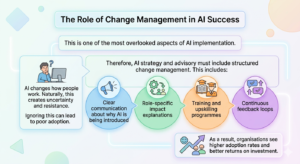
This is one of the most overlooked aspects of AI implementation.
AI changes how people work. Naturally, this creates uncertainty and resistance. However, ignoring this challenge can lead to poor adoption.
Therefore, AI strategy and advisory must include structured change management. This includes:
- Clear communication about why AI is being introduced
- Role-specific impact explanations
- Training and upskilling programmes
- Continuous feedback loops
As a result, organisations see higher adoption rates and better returns on investment.
How to Choose the Right AI Strategy and Advisory Partner
Not all advisory services deliver the same value. Therefore, selecting the right partner is critical.
Focus on Business Understanding
The best partners understand your industry and business model. They prioritise business outcomes over technical complexity.
Look for Honest Assessment
Strong partners challenge assumptions. For instance, they highlight data gaps or unrealistic expectations early.
This honesty prevents costly mistakes in AI implementation.
Demand Measurable Results
Case studies should include clear outcomes such as ROI, cost reduction, or time savings. Vague claims are not enough.
Ensure Ongoing Support
AI is not a one-time project. Instead, it requires continuous optimisation.
Therefore, choose a partner who offers long-term support beyond initial deployment.
Learn More About AI strategy and advisory
AI Maturity: A Critical Starting Point
Every organisation is at a different stage of AI adoption. Some are just beginning, while others are more advanced.
Understanding your AI maturity level is essential. It helps avoid two common mistakes:
- Overreaching before building a strong foundation
- Underutilising AI despite being ready for advanced use cases
Therefore, maturity assessment should be the first step in any AI strategy and advisory engagement.
The Compounding Advantage of Early AI Investment
AI advantage grows over time. Organisations that start early build stronger data systems and internal expertise.
As a result, each new AI initiative becomes faster and more effective. Meanwhile, competitors who delay fall further behind.
Therefore, the cost of waiting is not just lost opportunity—it is increasing competitive disadvantage.
Conclusion: Strategy Is the Multiplier
AI tools are widely available today. However, tools alone do not create value—strategy does.
AI strategy and advisory acts as the multiplier that turns AI investments into real business outcomes. Moreover, it separates organisations that experiment with AI from those that transform with it.
In conclusion, if your AI efforts have not delivered results, the solution is not another tool. Instead, it is a stronger, well-defined strategy.